Executive summary
Weak value propositions fail in predictable ways. Teams tell their story from the inside out, mistake features every competitor offers for differentiators, and treat proof that the product works as proof that customers care.
When Strategyzer coached around 10 product teams through a four-week value proposition programme, almost every team found that what it called its differentiators were table stakes.
The fix is a sequence: validate the customer profile, separate one primary value driver from reinforcing benefits and table stakes, map everyone who shapes the buying decision, then let AI draft the copy.
The clearest takeaway: start by hiding your product name and checking whether the story still holds.
Introduction
You know the slide. Three bullet points under the product name, each one a feature your team is proud of. Faster. More integrated. First in the category. It has been rewritten more times than anyone wants to admit, and it still does not land with the buyer.
So someone suggests running it through an AI tool. The output reads fine. It also reads like everyone else's page, because the model was given the same thing your competitors give theirs: a list of features and a request for enthusiasm.
The problem is not the words. It is what sits underneath them. Which customer, doing which job, held back by which pain. Which single outcome makes them pick you over the alternatives, including the alternative of doing nothing. And whether you have any evidence that they care.
That is the ground Strategyzer covered in this session on value propositions, drawing on a coaching programme with around 10 product teams and on how the Strategyzer team wrote its own website copy. The full recording is above if you want the demos. What follows is the argument, and the tools that carry it.
1. Your differentiators are probably table stakes
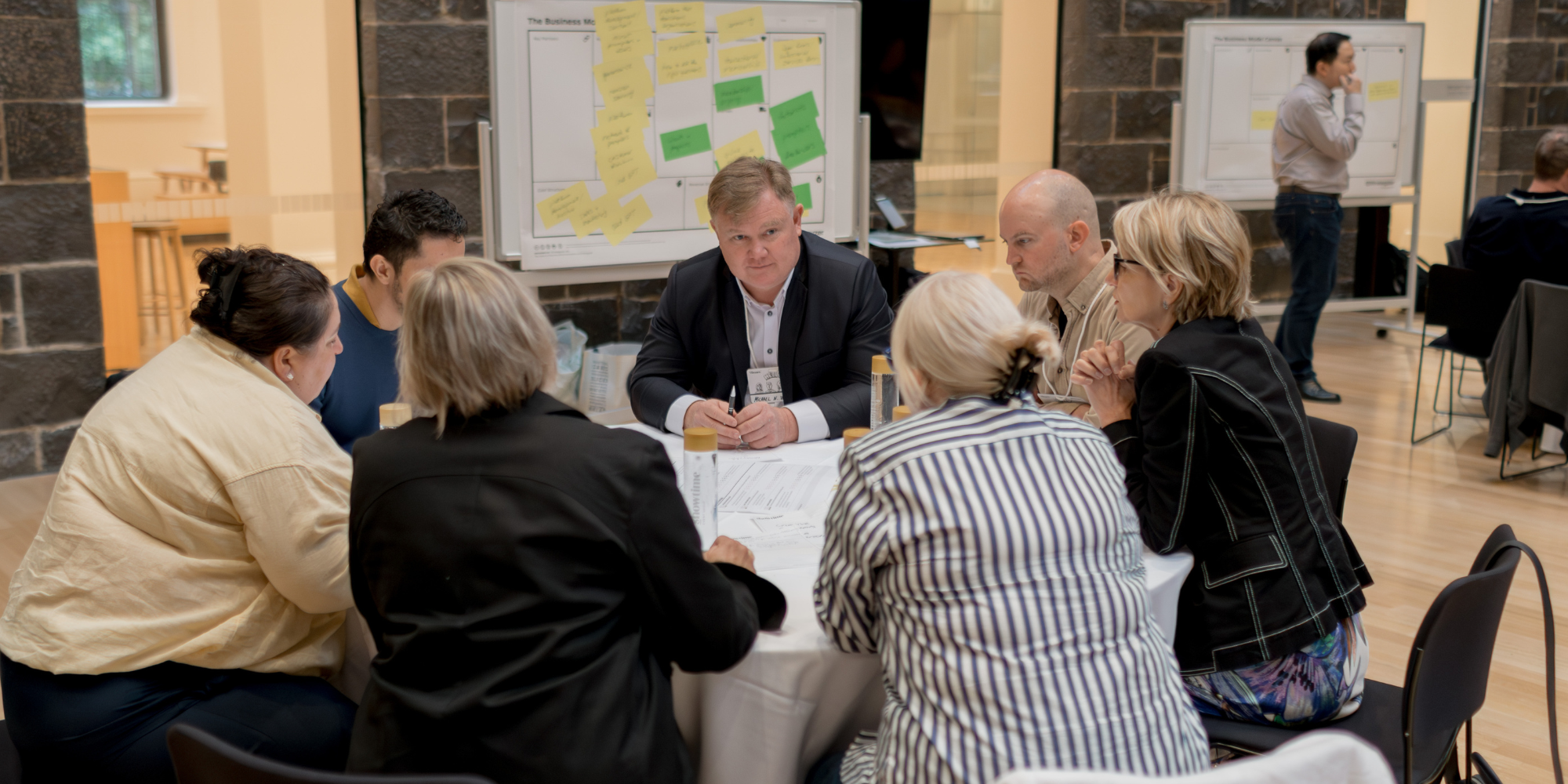
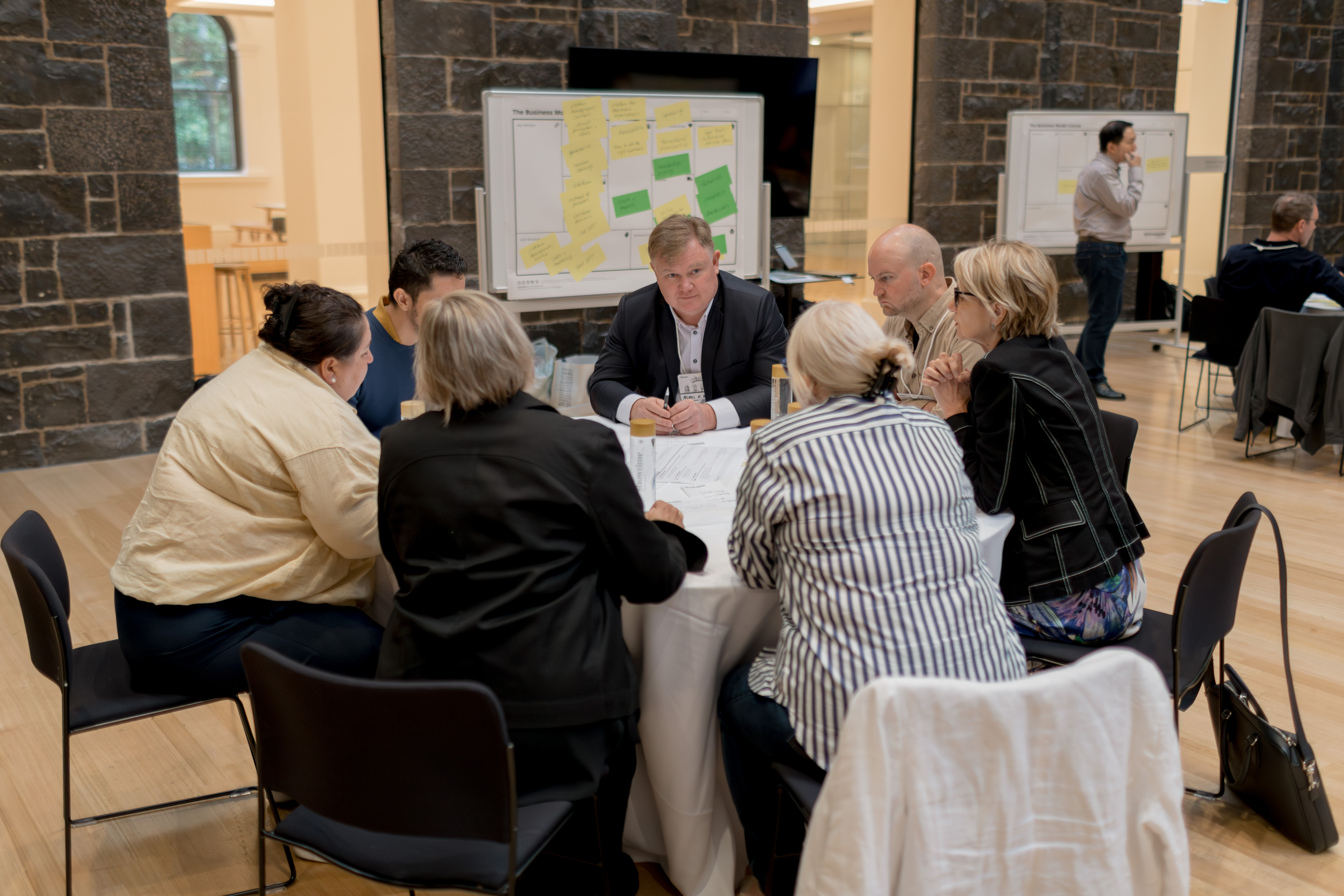
Strategyzer Associate Partner Carol Hill coached roughly 10 product teams over four weeks: around eight hours of asynchronous work in total, plus an hour of coaching each week, moving from customer understanding to value and differentiation, willingness to pay, and finally the story. Some teams already had products live in the market.
Hill asked each team to map its value proposition as it understood it today, then to name its top three differentiators. Then the teams sorted those claims using a new tool, the Value Stack. The result was consistent. Hill put it plainly: "almost every single time, they found that what they were considering their differentiators were actually table stakes".
Table stakes are what the whole market offers. They are the price of entry, not a reason to choose you.
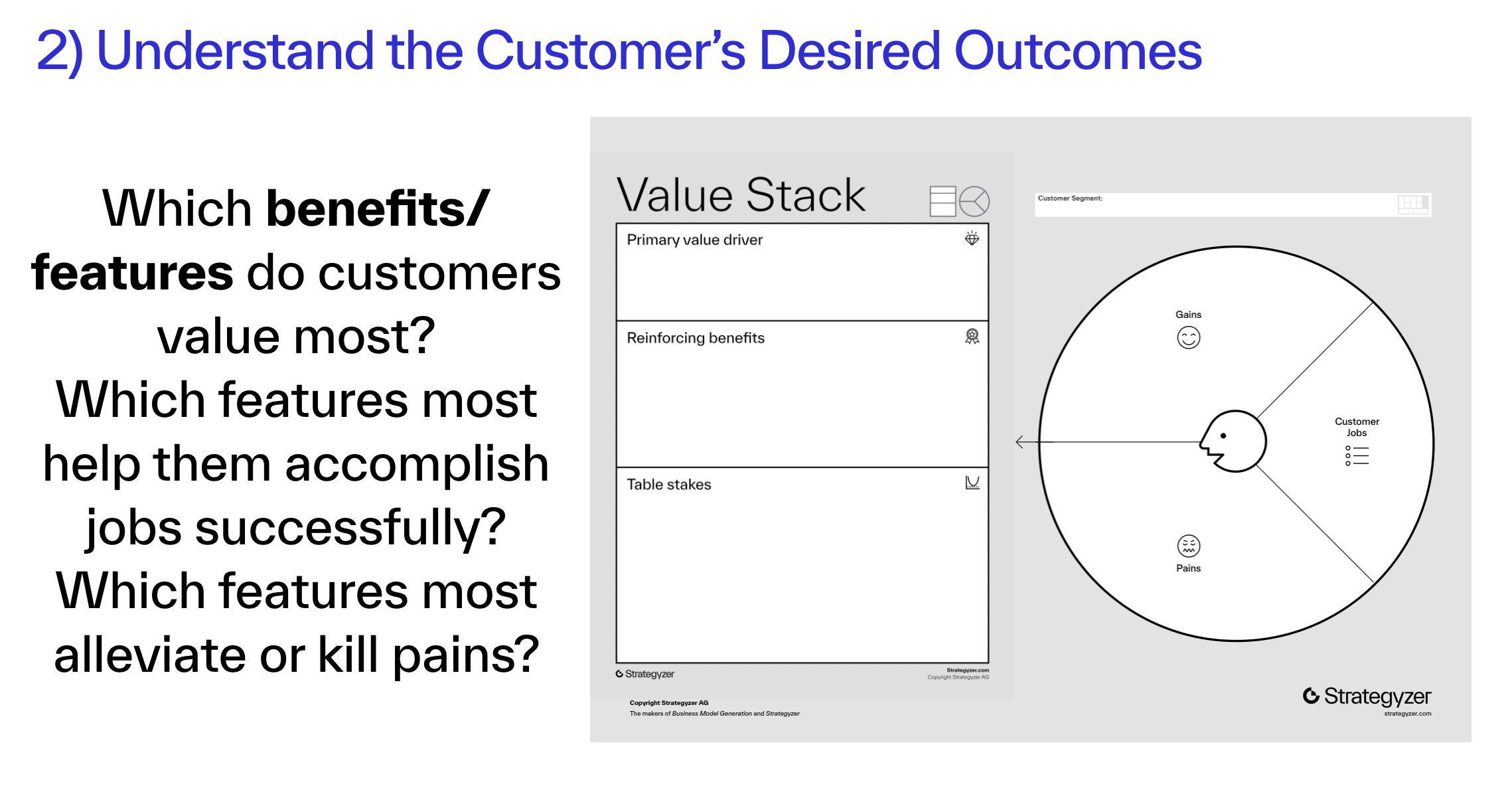
The Value Stack has three levels:
- Primary value driver. The one outcome that makes customers pick you over the alternatives.
- Reinforcing benefits. Differentiators that strengthen the primary driver but would not win the deal on their own.
- Table stakes. The features and benefits customers expect from anyone in the category.
Strategyzer Founder and CEO Alex Osterwalder was specific about what belongs at the top. The primary value driver "shouldn't be a feature. It's the thing, the outcome, the benefit, the main reason customers are going to pick you over alternatives". And he was clear that the alternatives include inertia: "Doing nothing is an alternative."
His worked example was Gmail at launch. The feature was 1GB of free storage. The benefit, and the primary value driver, was never having to delete an email again, at a time when storage was not free. Google-quality search in the inbox and conversation threading were real differentiators, but they were rarely the reason anyone switched. Reliable delivery and file sharing were table stakes.
Watch-out: Teams sort the stack by what they are proudest of, not by what the customer weighs. Run the competitor test from the session: would a competitor say the same thing? If yes, it is not your driver.
2. Hide the product name. Is it still about the customer?
The first aha moment Hill reported was more basic than the Value Stack. Teams had built their story from the inside out. "Our story was about us and not our customers."
The fix is the discipline the Value Proposition Canvas has always asked for: start with the customer circle, not the product square. Features, firsts and specifications belong on the right of the page, after you can say who it is for, what they are trying to get done, and why it matters to them. Hill offered a simple test to run on any draft: "if you were to hide the product name, is it still about the customer?"
An attendee asked the perennial startup question: start with the Value Proposition Canvas or the Business Model Canvas? Osterwalder refused the premise. You will go back and forth regardless, because a value proposition that needs an unaffordable business model sends you straight back to the drawing board.
"People who think it's a linear process, they've never actually built anything." – Alex Osterwalder, Founder and CEO, Strategyzer
Zoom out to the business model, zoom in to the customer profile, zoom out again to the competition. The order matters less than the loop.
What does not change is where the loop begins. Asked which playbook to start with to improve win rate, Playbook Designer Kurt Bostelaar pointed back to the foundations: "making sure you have those basics, you have a customer, you know their jobs, pains, and gains, you've validated that those are real". Formulating the proposition, and the copy, comes after.
3. Proof it works is not proof they care
Hill's third aha moment was about evidence. When she asked teams what customer evidence they had for jobs, pains and gains, she heard about feasibility tests: the solution works, customers might use it. Almost none of it showed that customers actually had the pains the team assumed.
That is the difference between evidence about your solution and evidence about your customer. Only the second kind tells you whether the value proposition is real.
The session separated "say" evidence from "do" evidence, and the slides placed them on a strength scale from 1 to 5. Five voice-of-customer interviews with end users sat at the weak end. A day-in-the-life observation of real commuters sat at the strong end. People report one thing and do another, so listen to what they say and pay attention to what they do.
Hill's instruction was to gather "the right kinds of evidence at the right time, so that you're not just thinking about fantasy".
Watch-out: A usability test or a technical pilot feels like customer evidence because customers were in the room. It validates the solution, not the pain. Before you claim a benefit, ask what evidence you hold that the customer has the problem, and what else you could test to get stronger evidence.
4. Buyers, plural
Most value proposition work imagines one buyer. In B2B, groups decide, and people who never sign the contract can still sway or sink the deal. Hill noted it holds in direct-to-consumer too: a travel mug for commuters has a spouse and a friend in the picture.
The tool for this is the Buying Decision Map. It asks you to lay out four things:
- Stakeholders: decision maker, budget holder, influencer, end user, channel partner, and the saboteur who could say no.
- Buying criteria: what each of them judges you on.
- Buying conditions: the circumstances under which a purchase happens, from long buying processes to gifting seasons.
- Budget: where the money comes from, and what else is competing for it.
That last question was the one Hill singled out. Thinking about what else competes for the budget is, in her words, "really stretching you and challenging you to think outside of your particular product". Your competitor is often not a rival product but a different line item entirely.
Watch-out: A value proposition written for the end user alone can be loved by the people who use it and killed by the person who pays. Write the primary value driver for the decision maker, and check it survives the budget holder's question.
5. AI writes good copy when you feed it the ingredients
Osterwalder's own story made the case for the sequence. In London, he and Strategyzer's product leader needed new copy for the playbook subscription page aimed at solo practitioners and entrepreneurs: a hero line, a hero paragraph and three outcome bullets.
They could have gone straight to the AI tool and iterated on wording. Instead they assembled what Osterwalder calls the value proposition ingredients:
- The customer profile and value map for that one segment, together the Value Proposition Canvas, later refined with more interviews.
- A list of the alternative solutions that segment could choose instead.
- A Value Stack: the number one benefit, then the reinforcing benefits, then the table stakes.
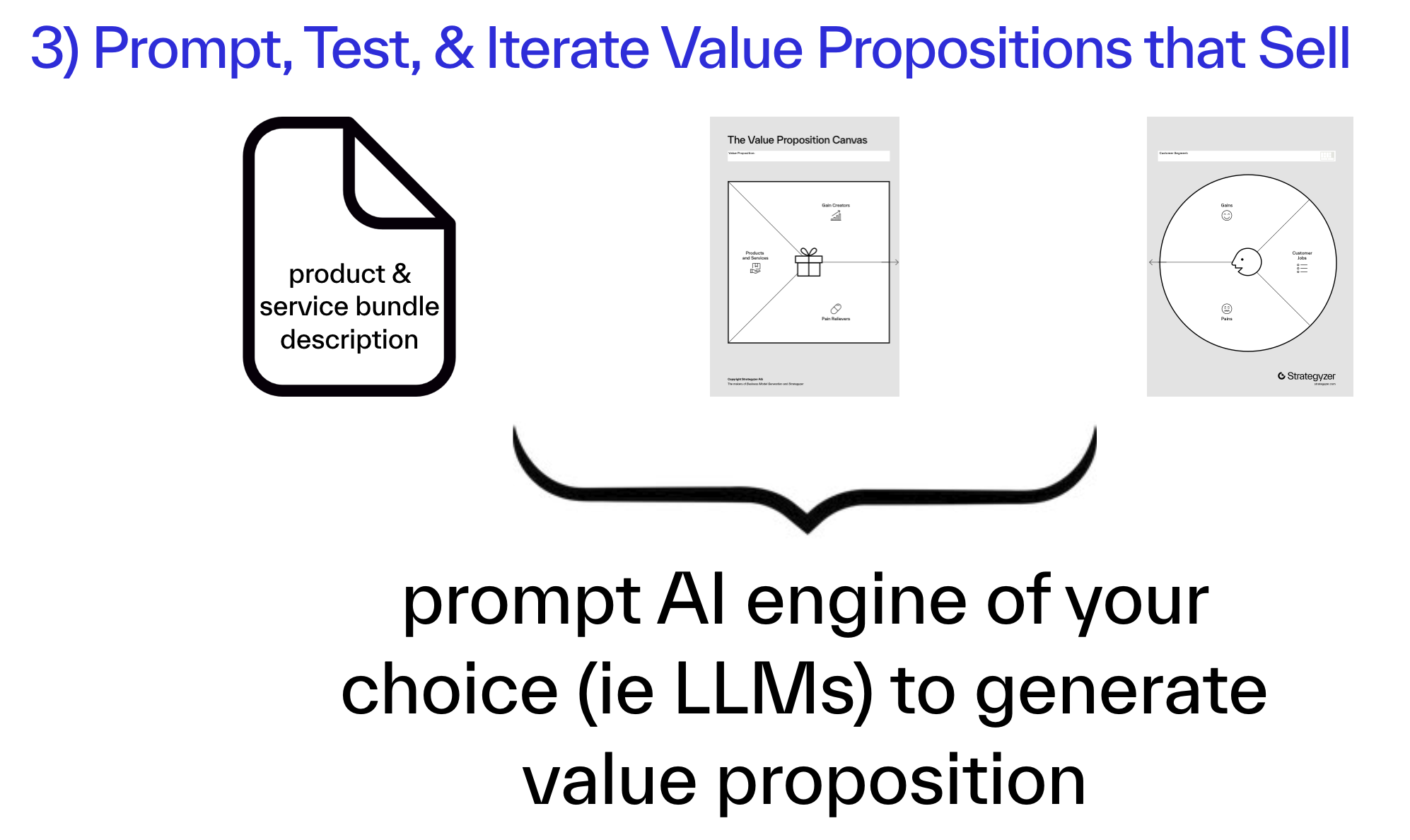
Then came the prompt, as shown on the slide: "Use the screenshots to create a hero line, hero paragraph, and three valued outcomes". The line that resulted, "Move your business forward with clarity", now sits on the page, with a paragraph and three bullets beneath it. The same process produced tailored hero copy for teams, for coaches and consultants, and for enterprises.
The AI did the wordsmithing. The thinking was done on the canvases first, which is why the output was specific rather than generic. This process is now a playbook, Strong value propositions and differentiation with Gen-AI, so that teams can run it step by step rather than reconstruct it.
Osterwalder's broader point was that this is not extra work. "When you do the work and you validate those, you're capturing all of the data while you're working." The canvases are the context the model needs.
Watch-out: Many organisations block customer data from external AI platforms. Osterwalder's answer to that question was practical: do the work on the canvases, then paste into whichever tool is approved internally, such as Copilot. Not ideal, but it works, and the thinking is portable.
6. Why this thinking now ships as a playbook, not a book
Everything above would once have been a book. Osterwalder and Yves Pigneur developed six patterns of value creation, with 27 flavours, and built the Value Stack alongside them. None of it went to a publisher. Osterwalder was blunt: "I'm not in the business of writing books anymore".
Bostelaar, who turns the thinking into step-by-step playbooks, described the format as "book, version 2": the content a book would carry, plus pre-structured workspaces to apply it, plus the ability to change it. Hill said the team is iterating on these tools between workshops as client feedback comes in.
The reason is not format preference. It is adoption. Osterwalder: "it's very hard to change an organisation based on books". A training session has the same limit. Hill described a client whose team came back from a course full of jobs, pains and gains and then had no way to keep using them.
"It's not just a training, it's actually getting teams to then use it on repeat." – Carol Hill
For larger organisations, the session showed custom playbook libraries: a private set of playbooks, some drawn from the Strategyzer library and some built for the organisation's own context. Osterwalder described one client defining three or four contexts and designing a playbook for each: one for leaders to assess value propositions, one for a three-week sprint to the fastest evidence, and one for the full process.
Pressure-test your value proposition
Five checks drawn from the session. Run them on your current draft before anyone touches the copy.
- Hide the product name. Is the story still about the customer?
- Name one primary value driver. Is it an outcome, not a feature?
- Would a competitor say the same thing? If so, it is a table stake.
- What evidence shows customers have the pain, rather than that your solution works? What else could you test?
- Who could say no to this deal, and what else is competing for the budget?
Conclusion
A value proposition is not a sentence you polish. It is a claim about who the customer is, what they weigh, and what they would otherwise do, and it is only as strong as the evidence behind each part.
The teams in the programme learned that their favourite features were the price of entry, and that their customer evidence was about the product. Four weeks was not enough to test as well; that work sat outside the programme and still has to be done.
Your first step costs nothing: write down your top three differentiators and sort them into the Value Stack with a colleague who sells.
Download the slides. The deck includes the Value Stack.
Get the playbook subscription. Master the patterns of value creation and Strong value propositions and differentiation with Gen-AI walk a team through the full sequence: customer profile, Value Stack, evidence, then AI-assisted copy. One subscription includes every playbook in the library. If you need to run this across many teams, a coached programme or a custom organisation library is the other track: talk to us.