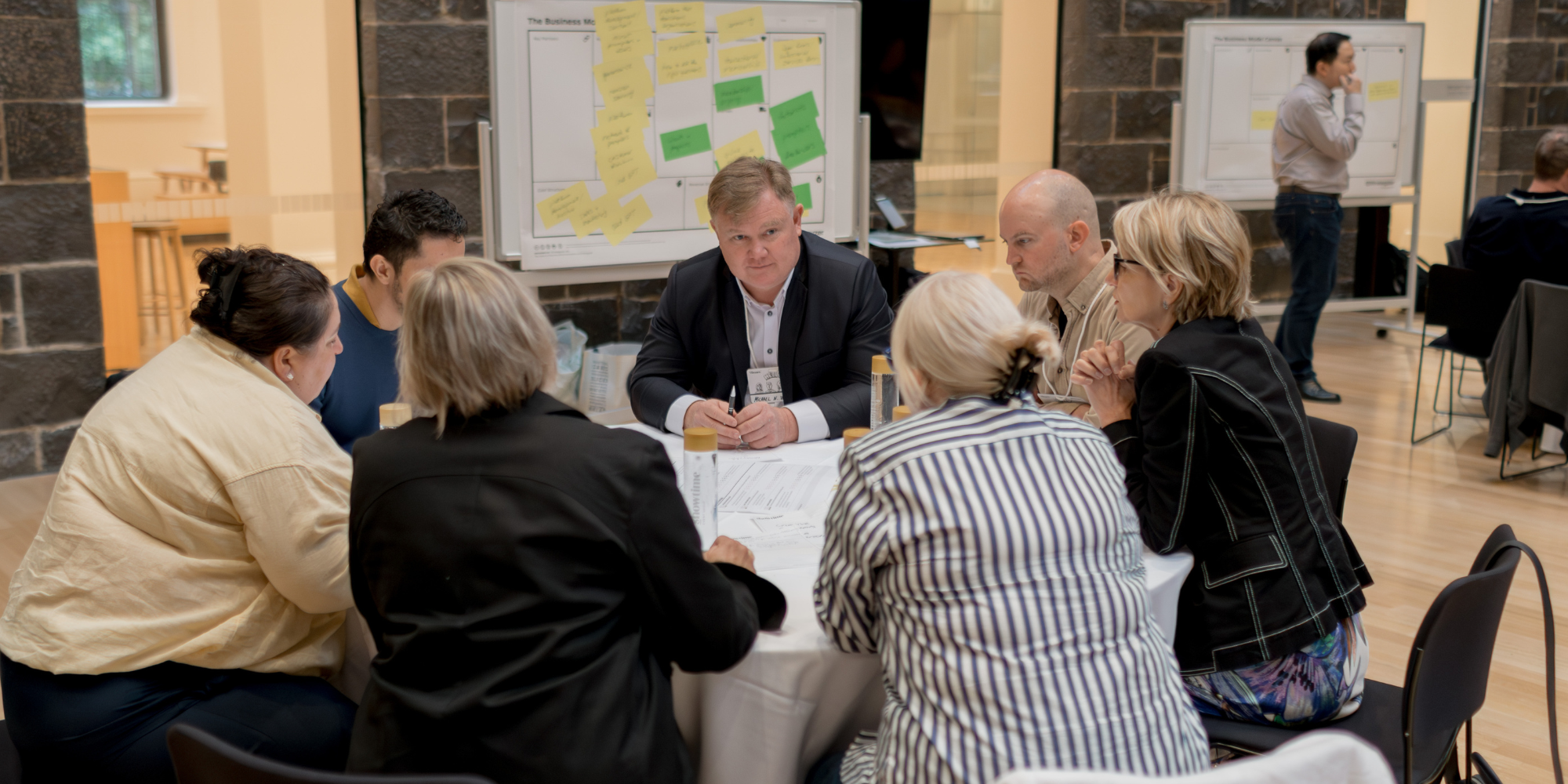
The Playbook to Run Great Strategy Session

Dr. Alex Osterwalder
Dr. Tendayi Viki
December 16, 2025
#
 min read
topics
No items found.

Most strategy sessions fail not from lack of expertise, but from lack of structure. After facilitating dozens of leadership workshops, we've identified how structured playbooks transform unfocused conversations into concrete strategic decisions—in hours, not months. This article shares two real examples from pharmaceutical and e-commerce companies that used step-by-step facilitation to design bold strategic moves while avoiding the common traps that keep teams stuck in incremental thinking.

Executive summary:

  • Unstructured strategy conversations waste time and resources, often devolving into unfocused discussions that jump between vision and implementation
  • Most companies confuse budgets and tactical plans with actual strategy, avoiding the bold choices required for sustained growth
  • Structured strategy playbooks provide step-by-step facilitation that helps leadership teams move from ambiguous conversations to concrete strategic decisions
  • Two practical examples demonstrate how pharmaceutical and e-commerce companies used playbooks to design bold strategic moves in hours, not months

The uncomfortable truth about your strategy sessions

You've likely witnessed this scene: A leadership team gathers for a strategy session. Someone mentions Egypt as a growing market. Another person immediately suggests which products to launch there. A third person questions whether the company decided last year to focus only on existing markets. Then someone else points out the challenges of customer access in Egypt. The conversation loops endlessly between high-level vision and granular implementation details. Hours pass. No decisions emerge.

"Most organizations don't actually have a strategy," observes strategy expert Roger Martin. "What they do have is a budget with just a set of tactics attached to it."

Our recent poll of over 1,000 innovation and strategy leaders confirmed this reality. When asked about their strategy sessions, the two highest-scoring characteristics were "decisions mostly driven by budgets and financial targets" and "conversations unstructured, moving from topic to topic." The lowest scoring? "Conversations structured in a well-facilitated workshop."

The gap between these responses reveals something critical: The problem isn't lack of knowledge about strategy. It's the inability to have structured conversations around difficult strategic topics.

What keeps strategy sessions stuck

After facilitating dozens of strategy sessions, we've identified four patterns that undermine strategic thinking:

Jumping between abstraction levels. Teams oscillate between long-term vision and immediate implementation without depth on any single topic.

Confusing budgets with strategy. Setting financial targets—"hit last year's revenue plus 5%"—isn't strategy. Strategy requires explicit choices about where to play and what to abandon.

Letting data make decisions. Mapping businesses against market sizes avoids making choices, leaving teams pursuing everything. Real strategy demands prioritization.

Building plans instead of strategy. A plan lists activities. Strategy articulates unique positioning based on bold choices about business models, value propositions, and markets.

These patterns share a common root: the absence of structure.

The hidden cost of the existing business model

Here's what makes strategic thinking particularly difficult: your current business model actively works against innovation. We call this the Osterwalder law: Your current business model will kill anything that looks different.

Our poll revealed that strategy in most organizations scores 3.9 out of 10 on future focus, with the vast majority of strategic energy directed toward improving existing business. This isn't necessarily wrong—you absolutely must keep the lights on. But the core business creates antibodies against anything unfamiliar.

"Bottom-up growth sounds appealing, but it will not happen without top-down protection," notes Alex Osterwalder, creator of the Business Model Canvas. "Bold strategic moves need to come from the top. That's something we don't see enough."

Consider Ping An, the Chinese insurance and financial services company. When founder Peter Ma recognized that emerging technologies would reshape their industry, he made explicit strategic choices. Ping An invested 10% of profits into exploring fintech, healthcare, automobile services, and smart city technologies while simultaneously improving their core insurance and banking operations. This wasn't accidental. It required deliberate resource allocation toward future-focused exploration alongside execution excellence in existing business.

Similarly, when Bracken Darrell led Logitech, he championed a "trees, plants, and seeds" philosophy. Knowing their computer peripherals business would eventually decline, he systematically shifted resources toward emerging areas like PC gaming and audio while the core business still thrived. These strategic choices distinguished Logitech from competitors who waited too long to evolve.

The difference between companies that successfully navigate disruption and those that don't comes down to structured decision-making that forces explicit trade-offs between protecting today's business and building tomorrow's.

How playbooks change the conversation

A strategy playbook is a pre-designed, step-by-step facilitation guide that structures complex strategic conversations. Think of it as the difference between unstructured brainstorming and a well-orchestrated workshop where every activity builds toward a specific outcome.

Here's why playbooks work:

They prevent conversational drift. By defining clear stages, playbooks keep teams focused on one strategic question at a time.

They democratize facilitation expertise. The knowledge of how to design world-class strategy sessions becomes accessible without requiring an experienced external facilitator.

They force explicit choices. Rather than allowing teams to hedge, playbooks include decision points with specific frameworks for prioritization.

They balance creativity and constraint. Playbooks use scenarios and trigger questions to push teams beyond comfortable incrementalism while channeling creative energy productively.

Most importantly: You don't need more time or money to dramatically improve your strategy. You need better design and facilitation of the conversations themselves.

Real example: Transforming a pharmaceutical giant's approach

A century-old pharmaceutical company faced mounting pressure from new entrants compressing margins in generics while growth opportunities emerged in Asia. Uncertainty about viable business models left leadership unclear about bold moves.

The strategy playbook structured the conversation through five stages:

Mapping the business environment. The team used the Business Environment Canvas to identify industry forces, trends, market dynamics, and macroeconomic factors. This created shared understanding of external pressures demanding response.

Scoring disruption risks. Using the Disruption Risk Assessment, leaders quantified threats: "New entrants gaining traction. Markets projected to shrink. Customer preferences shifting away from our value proposition."

Inspiring strategic thinking. To address the generics threat, the playbook used Clayton Christensen's advice: When facing low-end disruption, consider launching your own low-end offering. Trigger questions prompted teams to explore self-disruption.

Generating exploration ideas. For new opportunities, the playbook provided three lenses with real-world examples and specific prompts: customer-driven moves (tapping underserved markets), resource-driven moves (leveraging IP in difficult markets), and finance-driven moves (new revenue models).

Making decisions with structured feedback. Teams used Edward de Bono's thinking hats: one minute for clarifying questions (white hat), one minute identifying risks (black hat), one minute highlighting strengths (yellow hat), one minute suggesting improvements (green hat). This compressed hours of circular discussion into minutes of actionable insight.
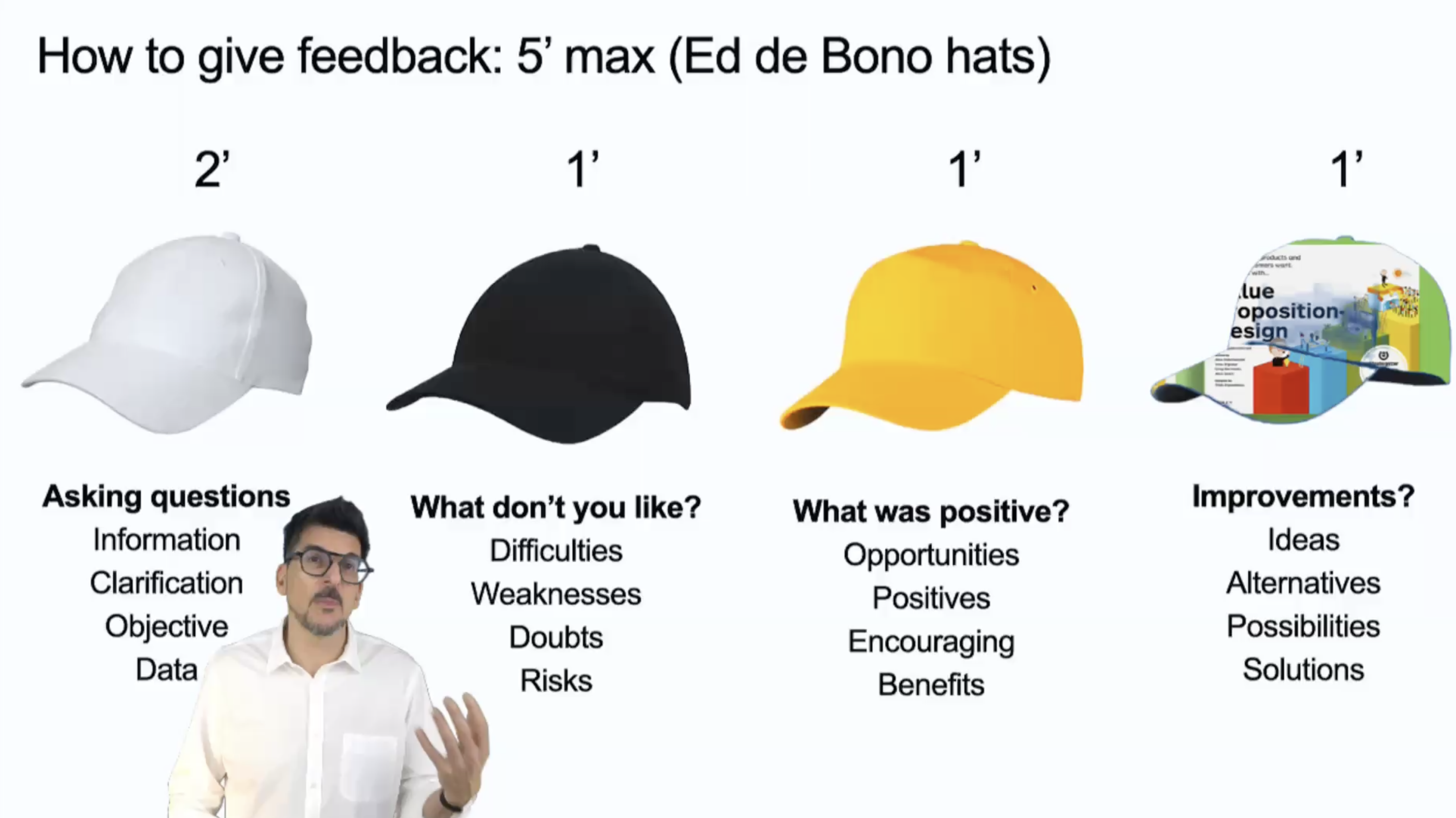
Ed de Bono's thinking hats usage for constructive feedback

The entire process took a single day. The outcome? Four bold strategic moves with clear prioritization and identified capability gaps. Most importantly, the structured approach prevented teams from discussing capability constraints prematurely—a pattern that kills innovative thinking.

"When you structure the conversation, people stop veering off in different directions," notes Tendayi Viki, senior partner at Strategyzer. "Leaders are often quite pleased because they've actively worked together and made decisions in context rather than creating long plans and decks."

Real example: Pushing an e-commerce company beyond incremental thinking

A 20-year-old e-commerce company had built consistent success on an innovative business model. But that same model created a trap: The leadership team excelled at operational improvement but struggled to imagine bold strategic alternatives. With new competitors leveraging AI and agentic commerce threatening traditional e-commerce, the company needed to break out of comfortable incrementalism.

The playbook for this session used scenarios to force uncomfortable thinking:

Scenario 1: 80% recurring revenue. Two teams had to imagine a future where their company generated 80% of revenues through recurring subscriptions. The entire day's work would reverse-engineer the business model required to reach that future state. This wasn't about predicting the future—it was about escaping the gravitational pull of their current model.

Scenario 2: Leveraging agentic commerce. The other two teams explored how to embrace agentic AI while protecting their key assets: brand strength and community engagement. Again, the scenario eliminated the option of minor tweaks to existing operations.

The playbook then walked teams through progressive development:

Generating ideas through trigger questions. Rather than asking, "What should we do?" the playbook posed specific prompts that pushed beyond obvious answers. Quantity mattered more than initial quality—the goal was expansive thinking before convergence.

Synthesizing into napkin sketches. Each team created two visual concepts: a title, an image, and a paragraph explaining one bold strategic move. These napkin sketches made abstract ideas concrete enough to evaluate.
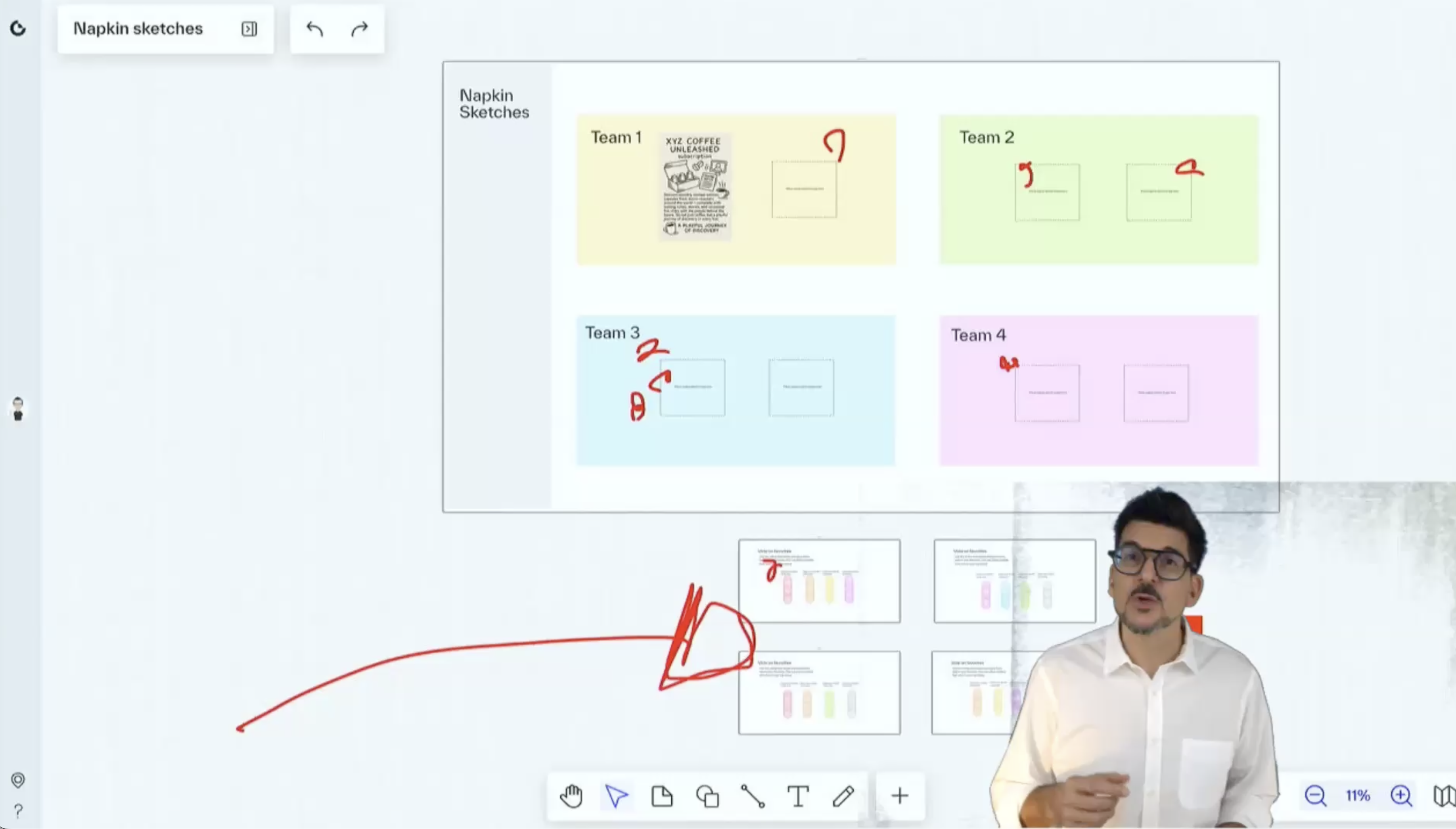
Strategyzer playbook and platform in action - Napkin sketches

Democratic selection. Teams presented their napkin sketches to peers. Every participant voted using dots to indicate preferred directions. Each team then developed the highest-voted concept, ensuring collective buy-in while maintaining focus.

Building out the strategy. Teams progressively detailed their chosen move: mapping the customer profile, creating value scenes (visual stories showing the customer's moment of need, current alternatives, and improved future state), designing the business model, and sketching preliminary financials.

Testing assumptions. Before pitching their strategies, teams identified what evidence already supported their ideas and what key hypotheses required testing. This shifted the conversation from "Is this the right answer?" to "How do we learn whether this could work?"

Structured feedback using thinking hats. After five-minute presentations, audiences provided white hat clarification questions, black hat concerns, yellow hat strengths, and green hat improvements. The presenting team remained silent during negative feedback, preventing defensive responses that waste time and energy.

The entire process ran from 9 AM to 4 PM. Four teams developed four distinct strategic prototypes for the company's future. Rather than choosing a single winner, the leadership team could now test multiple directions with clear hypotheses.

"What blows me away," reflects Osterwalder, "is that you have the same smart people, all the knowledge is in the room, you don't need more time or money. The only difference between a world-class strategy session and a blah, blah conversation is whether you designed and facilitated it. Once you have the design, the rest is straightforward."

The elements that make playbooks effective

Analyzing the playbooks used across dozens of strategy sessions reveals common structural elements:

Clear framing upfront. Effective playbooks establish the destination before the journey begins. Teams understand what they'll present at the end of the day—typically a five-minute pitch covering why the idea matters, customer value, business model, supporting evidence, and key testing hypotheses.

Progressive specificity. Playbooks move from divergent exploration to convergent detail. Teams generate many possibilities, synthesize into a few concepts, select one direction, then progressively add layers of specificity: customer profiles, value propositions, business models, preliminary numbers.

Forced choice moments. Rather than allowing teams to hedge, playbooks include explicit decision mechanisms: dot voting, matrix prioritization, or facilitated discussion with clear criteria. These choices create momentum and prevent analysis paralysis.

Constraints that liberate creativity. Scenarios, time limits, and specific frameworks paradoxically increase creativity by eliminating the blank page problem. When two teams must design an 80% recurring revenue model, they can't default to incremental thinking.

Separation of generation and evaluation. During ideation phases, playbooks explicitly prohibit criticism. During feedback phases, playbooks use structured methods (like thinking hats) to compress evaluation without descending into unproductive debate. This separation prevents premature convergence and unnecessary conflict.

Visual and spatial thinking. Playbooks consistently emphasize visual representations: napkin sketches, value scenes, canvas-based business models. This makes abstract strategy tangible and creates shared artifacts that align understanding.

Evidence-based and hypothesis-driven. Rather than treating strategic choices as pure predictions, playbooks frame them as hypotheses requiring testing. Teams identify what evidence already supports their thinking and what uncertainties demand experimentation.

The power of these elements lies in their combination. Any single component might feel obvious, but the sequencing and integration create the structure that transforms strategic conversations.

Moving from playbooks to action

Structured playbooks solve the facilitation challenge, but two critical factors determine whether strategy sessions actually generate results:

The right people must participate. Strategy sessions require participants with relevant expertise and authority. Sometimes that means technical R&D capabilities, sometimes market knowledge, sometimes financial decision-making power. The playbook structure doesn't compensate for missing perspectives or absent decision-makers.

Bold strategies require testing, not just funding. One common concern: "Won't finance reject choices that haven't been properly proposed?" The answer lies in framing strategy as hypothesis-driven exploration rather than final commitment. Not all strategies need immediate large investments. Many require quick experimentation to validate assumptions before scaling.

This testing mindset addresses another common pattern: discussing capability gaps too early kills bold thinking. Structure the conversation to separate bold move generation from capability assessment. Design the strategy, make the choice, then identify and address capability gaps. This sequence prevents premature rejection of ideas that might be viable with modest capability building.
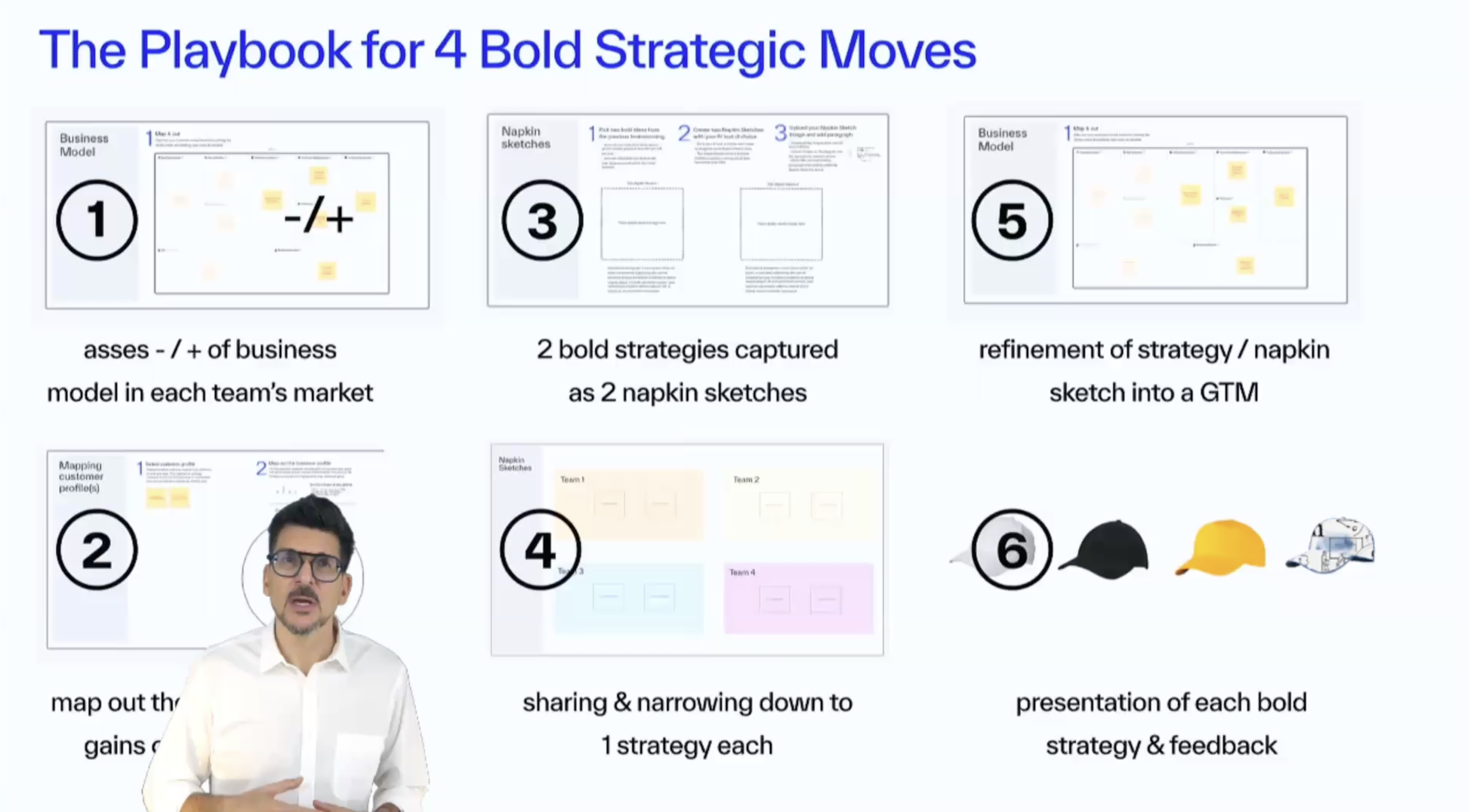
The Playbook for 4 Bold Strategic Moves - Real Example

What you can do next

If your organization struggles with unfocused strategy sessions that generate plans rather than strategic choices, consider these steps:

Assess your current approach. Before your next strategy session, observe the conversation patterns. Are teams jumping between abstraction levels? Is there explicit discussion of what not to do? Are decisions driven by bold choices about where to play, or by financial targets and budgets?

Start with structured frameworks for single topics. You don't need to overhaul your entire approach immediately. Try using the Business Environment Canvas for one session focused only on external forces. Use de Bono's thinking hats for feedback on a single initiative. These small experiments demonstrate the power of structure without requiring complete commitment.

Design before you facilitate. The most common failure mode is assuming smart people in a room will self-organize toward productive strategy. Before your next session, map out the sequence: What question do we start with? What activities will move us toward decisions? What will we present at the end? This pre-design dramatically improves outcomes.

Separate exploration from execution conversations. If your strategy sessions constantly veer between bold future moves and current business optimization, run separate sessions for each. The exploration conversation requires different mindsets, participants, and facilitation than execution planning.

Make choices explicit and visible. Strategy isn't real until you can articulate what you're choosing not to do. Every strategic decision should clearly state: "We're choosing to pursue X, which means we're explicitly not pursuing Y and Z." This specificity prevents the hedging that dilutes strategic impact.

The organizations that navigate disruption successfully don't possess secret knowledge. They structure the conversations where strategy gets made. That structure can be learned, applied, and shared. The question is whether you'll continue accepting unfocused strategy sessions as inevitable, or whether you'll design the facilitation that makes the difference.

Want to see these playbooks in action? The Strategyzer platform provides access to a library of structured playbooks for strategy sessions, portfolio management, and business model innovation. Learn more at strategyzer.com/playbooks.

related reads
No items found.

About the speakers

Dr. Alex Osterwalder
Entrepreneur, speaker and business thinker

Co-founder of Strategyzer and creator of the Business Model Canvas. Alex has helped hundreds of organisations design and iterate their strategies using practical, visual tools that turn complex challenges into actionable moves.

Dr. Tendayi Viki
Author, Speaker, Advisor

Senior Partner at Strategyzer and author of multiple books on innovation and strategy. Tendayi regularly leads strategy workshops for Fortune 500 companies, helping leadership teams navigate disruption and make bold decisions with confidence

by 
Dr. Alex Osterwalder
Dr. Tendayi Viki
December 16, 2025
Share

Download your free copy of this whitepaper now

  • 1
  • 2
  • 3
Team member avatarTeam member avatarTeam member avatarTeam member avatarTeam member avatarTeam member avatarMattTeam member avatarTeam member avatarTeam member avatarTeam member avatarTeam member avatar
Let's talk
Want to make innovation work in your organization? Connect with us to explore practical solutions that fit your needs. We'll help you build ideas that deliver measurable results.
Thanks for your interest in our solutions. We will be in touch with you soon.
The Playbook to Run Great Strategy Session
Webinars

The Playbook to Run Great Strategy Session

December 16, 2025
#
 min read
topics
No items found.

Most strategy sessions fail not from lack of expertise, but from lack of structure. After facilitating dozens of leadership workshops, we've identified how structured playbooks transform unfocused conversations into concrete strategic decisions—in hours, not months. This article shares two real examples from pharmaceutical and e-commerce companies that used step-by-step facilitation to design bold strategic moves while avoiding the common traps that keep teams stuck in incremental thinking.

Executive summary:

  • Unstructured strategy conversations waste time and resources, often devolving into unfocused discussions that jump between vision and implementation
  • Most companies confuse budgets and tactical plans with actual strategy, avoiding the bold choices required for sustained growth
  • Structured strategy playbooks provide step-by-step facilitation that helps leadership teams move from ambiguous conversations to concrete strategic decisions
  • Two practical examples demonstrate how pharmaceutical and e-commerce companies used playbooks to design bold strategic moves in hours, not months

The uncomfortable truth about your strategy sessions

You've likely witnessed this scene: A leadership team gathers for a strategy session. Someone mentions Egypt as a growing market. Another person immediately suggests which products to launch there. A third person questions whether the company decided last year to focus only on existing markets. Then someone else points out the challenges of customer access in Egypt. The conversation loops endlessly between high-level vision and granular implementation details. Hours pass. No decisions emerge.

"Most organizations don't actually have a strategy," observes strategy expert Roger Martin. "What they do have is a budget with just a set of tactics attached to it."

Our recent poll of over 1,000 innovation and strategy leaders confirmed this reality. When asked about their strategy sessions, the two highest-scoring characteristics were "decisions mostly driven by budgets and financial targets" and "conversations unstructured, moving from topic to topic." The lowest scoring? "Conversations structured in a well-facilitated workshop."

The gap between these responses reveals something critical: The problem isn't lack of knowledge about strategy. It's the inability to have structured conversations around difficult strategic topics.

What keeps strategy sessions stuck

After facilitating dozens of strategy sessions, we've identified four patterns that undermine strategic thinking:

Jumping between abstraction levels. Teams oscillate between long-term vision and immediate implementation without depth on any single topic.

Confusing budgets with strategy. Setting financial targets—"hit last year's revenue plus 5%"—isn't strategy. Strategy requires explicit choices about where to play and what to abandon.

Letting data make decisions. Mapping businesses against market sizes avoids making choices, leaving teams pursuing everything. Real strategy demands prioritization.

Building plans instead of strategy. A plan lists activities. Strategy articulates unique positioning based on bold choices about business models, value propositions, and markets.

These patterns share a common root: the absence of structure.

The hidden cost of the existing business model

Here's what makes strategic thinking particularly difficult: your current business model actively works against innovation. We call this the Osterwalder law: Your current business model will kill anything that looks different.

Our poll revealed that strategy in most organizations scores 3.9 out of 10 on future focus, with the vast majority of strategic energy directed toward improving existing business. This isn't necessarily wrong—you absolutely must keep the lights on. But the core business creates antibodies against anything unfamiliar.

"Bottom-up growth sounds appealing, but it will not happen without top-down protection," notes Alex Osterwalder, creator of the Business Model Canvas. "Bold strategic moves need to come from the top. That's something we don't see enough."

Consider Ping An, the Chinese insurance and financial services company. When founder Peter Ma recognized that emerging technologies would reshape their industry, he made explicit strategic choices. Ping An invested 10% of profits into exploring fintech, healthcare, automobile services, and smart city technologies while simultaneously improving their core insurance and banking operations. This wasn't accidental. It required deliberate resource allocation toward future-focused exploration alongside execution excellence in existing business.

Similarly, when Bracken Darrell led Logitech, he championed a "trees, plants, and seeds" philosophy. Knowing their computer peripherals business would eventually decline, he systematically shifted resources toward emerging areas like PC gaming and audio while the core business still thrived. These strategic choices distinguished Logitech from competitors who waited too long to evolve.

The difference between companies that successfully navigate disruption and those that don't comes down to structured decision-making that forces explicit trade-offs between protecting today's business and building tomorrow's.

How playbooks change the conversation

A strategy playbook is a pre-designed, step-by-step facilitation guide that structures complex strategic conversations. Think of it as the difference between unstructured brainstorming and a well-orchestrated workshop where every activity builds toward a specific outcome.

Here's why playbooks work:

They prevent conversational drift. By defining clear stages, playbooks keep teams focused on one strategic question at a time.

They democratize facilitation expertise. The knowledge of how to design world-class strategy sessions becomes accessible without requiring an experienced external facilitator.

They force explicit choices. Rather than allowing teams to hedge, playbooks include decision points with specific frameworks for prioritization.

They balance creativity and constraint. Playbooks use scenarios and trigger questions to push teams beyond comfortable incrementalism while channeling creative energy productively.

Most importantly: You don't need more time or money to dramatically improve your strategy. You need better design and facilitation of the conversations themselves.

Real example: Transforming a pharmaceutical giant's approach

A century-old pharmaceutical company faced mounting pressure from new entrants compressing margins in generics while growth opportunities emerged in Asia. Uncertainty about viable business models left leadership unclear about bold moves.

The strategy playbook structured the conversation through five stages:

Mapping the business environment. The team used the Business Environment Canvas to identify industry forces, trends, market dynamics, and macroeconomic factors. This created shared understanding of external pressures demanding response.

Scoring disruption risks. Using the Disruption Risk Assessment, leaders quantified threats: "New entrants gaining traction. Markets projected to shrink. Customer preferences shifting away from our value proposition."

Inspiring strategic thinking. To address the generics threat, the playbook used Clayton Christensen's advice: When facing low-end disruption, consider launching your own low-end offering. Trigger questions prompted teams to explore self-disruption.

Generating exploration ideas. For new opportunities, the playbook provided three lenses with real-world examples and specific prompts: customer-driven moves (tapping underserved markets), resource-driven moves (leveraging IP in difficult markets), and finance-driven moves (new revenue models).

Making decisions with structured feedback. Teams used Edward de Bono's thinking hats: one minute for clarifying questions (white hat), one minute identifying risks (black hat), one minute highlighting strengths (yellow hat), one minute suggesting improvements (green hat). This compressed hours of circular discussion into minutes of actionable insight.

Ed de Bono's thinking hats usage for constructive feedback

The entire process took a single day. The outcome? Four bold strategic moves with clear prioritization and identified capability gaps. Most importantly, the structured approach prevented teams from discussing capability constraints prematurely—a pattern that kills innovative thinking.

"When you structure the conversation, people stop veering off in different directions," notes Tendayi Viki, senior partner at Strategyzer. "Leaders are often quite pleased because they've actively worked together and made decisions in context rather than creating long plans and decks."

Real example: Pushing an e-commerce company beyond incremental thinking

A 20-year-old e-commerce company had built consistent success on an innovative business model. But that same model created a trap: The leadership team excelled at operational improvement but struggled to imagine bold strategic alternatives. With new competitors leveraging AI and agentic commerce threatening traditional e-commerce, the company needed to break out of comfortable incrementalism.

The playbook for this session used scenarios to force uncomfortable thinking:

Scenario 1: 80% recurring revenue. Two teams had to imagine a future where their company generated 80% of revenues through recurring subscriptions. The entire day's work would reverse-engineer the business model required to reach that future state. This wasn't about predicting the future—it was about escaping the gravitational pull of their current model.

Scenario 2: Leveraging agentic commerce. The other two teams explored how to embrace agentic AI while protecting their key assets: brand strength and community engagement. Again, the scenario eliminated the option of minor tweaks to existing operations.

The playbook then walked teams through progressive development:

Generating ideas through trigger questions. Rather than asking, "What should we do?" the playbook posed specific prompts that pushed beyond obvious answers. Quantity mattered more than initial quality—the goal was expansive thinking before convergence.

Synthesizing into napkin sketches. Each team created two visual concepts: a title, an image, and a paragraph explaining one bold strategic move. These napkin sketches made abstract ideas concrete enough to evaluate.

Strategyzer playbook and platform in action - Napkin sketches

Democratic selection. Teams presented their napkin sketches to peers. Every participant voted using dots to indicate preferred directions. Each team then developed the highest-voted concept, ensuring collective buy-in while maintaining focus.

Building out the strategy. Teams progressively detailed their chosen move: mapping the customer profile, creating value scenes (visual stories showing the customer's moment of need, current alternatives, and improved future state), designing the business model, and sketching preliminary financials.

Testing assumptions. Before pitching their strategies, teams identified what evidence already supported their ideas and what key hypotheses required testing. This shifted the conversation from "Is this the right answer?" to "How do we learn whether this could work?"

Structured feedback using thinking hats. After five-minute presentations, audiences provided white hat clarification questions, black hat concerns, yellow hat strengths, and green hat improvements. The presenting team remained silent during negative feedback, preventing defensive responses that waste time and energy.

The entire process ran from 9 AM to 4 PM. Four teams developed four distinct strategic prototypes for the company's future. Rather than choosing a single winner, the leadership team could now test multiple directions with clear hypotheses.

"What blows me away," reflects Osterwalder, "is that you have the same smart people, all the knowledge is in the room, you don't need more time or money. The only difference between a world-class strategy session and a blah, blah conversation is whether you designed and facilitated it. Once you have the design, the rest is straightforward."

The elements that make playbooks effective

Analyzing the playbooks used across dozens of strategy sessions reveals common structural elements:

Clear framing upfront. Effective playbooks establish the destination before the journey begins. Teams understand what they'll present at the end of the day—typically a five-minute pitch covering why the idea matters, customer value, business model, supporting evidence, and key testing hypotheses.

Progressive specificity. Playbooks move from divergent exploration to convergent detail. Teams generate many possibilities, synthesize into a few concepts, select one direction, then progressively add layers of specificity: customer profiles, value propositions, business models, preliminary numbers.

Forced choice moments. Rather than allowing teams to hedge, playbooks include explicit decision mechanisms: dot voting, matrix prioritization, or facilitated discussion with clear criteria. These choices create momentum and prevent analysis paralysis.

Constraints that liberate creativity. Scenarios, time limits, and specific frameworks paradoxically increase creativity by eliminating the blank page problem. When two teams must design an 80% recurring revenue model, they can't default to incremental thinking.

Separation of generation and evaluation. During ideation phases, playbooks explicitly prohibit criticism. During feedback phases, playbooks use structured methods (like thinking hats) to compress evaluation without descending into unproductive debate. This separation prevents premature convergence and unnecessary conflict.

Visual and spatial thinking. Playbooks consistently emphasize visual representations: napkin sketches, value scenes, canvas-based business models. This makes abstract strategy tangible and creates shared artifacts that align understanding.

Evidence-based and hypothesis-driven. Rather than treating strategic choices as pure predictions, playbooks frame them as hypotheses requiring testing. Teams identify what evidence already supports their thinking and what uncertainties demand experimentation.

The power of these elements lies in their combination. Any single component might feel obvious, but the sequencing and integration create the structure that transforms strategic conversations.

Moving from playbooks to action

Structured playbooks solve the facilitation challenge, but two critical factors determine whether strategy sessions actually generate results:

The right people must participate. Strategy sessions require participants with relevant expertise and authority. Sometimes that means technical R&D capabilities, sometimes market knowledge, sometimes financial decision-making power. The playbook structure doesn't compensate for missing perspectives or absent decision-makers.

Bold strategies require testing, not just funding. One common concern: "Won't finance reject choices that haven't been properly proposed?" The answer lies in framing strategy as hypothesis-driven exploration rather than final commitment. Not all strategies need immediate large investments. Many require quick experimentation to validate assumptions before scaling.

This testing mindset addresses another common pattern: discussing capability gaps too early kills bold thinking. Structure the conversation to separate bold move generation from capability assessment. Design the strategy, make the choice, then identify and address capability gaps. This sequence prevents premature rejection of ideas that might be viable with modest capability building.

The Playbook for 4 Bold Strategic Moves - Real Example

What you can do next

If your organization struggles with unfocused strategy sessions that generate plans rather than strategic choices, consider these steps:

Assess your current approach. Before your next strategy session, observe the conversation patterns. Are teams jumping between abstraction levels? Is there explicit discussion of what not to do? Are decisions driven by bold choices about where to play, or by financial targets and budgets?

Start with structured frameworks for single topics. You don't need to overhaul your entire approach immediately. Try using the Business Environment Canvas for one session focused only on external forces. Use de Bono's thinking hats for feedback on a single initiative. These small experiments demonstrate the power of structure without requiring complete commitment.

Design before you facilitate. The most common failure mode is assuming smart people in a room will self-organize toward productive strategy. Before your next session, map out the sequence: What question do we start with? What activities will move us toward decisions? What will we present at the end? This pre-design dramatically improves outcomes.

Separate exploration from execution conversations. If your strategy sessions constantly veer between bold future moves and current business optimization, run separate sessions for each. The exploration conversation requires different mindsets, participants, and facilitation than execution planning.

Make choices explicit and visible. Strategy isn't real until you can articulate what you're choosing not to do. Every strategic decision should clearly state: "We're choosing to pursue X, which means we're explicitly not pursuing Y and Z." This specificity prevents the hedging that dilutes strategic impact.

The organizations that navigate disruption successfully don't possess secret knowledge. They structure the conversations where strategy gets made. That structure can be learned, applied, and shared. The question is whether you'll continue accepting unfocused strategy sessions as inevitable, or whether you'll design the facilitation that makes the difference.

Want to see these playbooks in action? The Strategyzer platform provides access to a library of structured playbooks for strategy sessions, portfolio management, and business model innovation. Learn more at strategyzer.com/playbooks.

related reads
Methods
How to design great workshops
Insights
Strategyzer master workshops: learn what it takes to create a world-class innovation engine
The Playbook to Run Great Strategy Session

Most strategy sessions fail not from lack of expertise, but from lack of structure. After facilitating dozens of leadership workshops, we've identified how structured playbooks transform unfocused conversations into concrete strategic decisions—in hours, not months. This article shares two real examples from pharmaceutical and e-commerce companies that used step-by-step facilitation to design bold strategic moves while avoiding the common traps that keep teams stuck in incremental thinking.

Thanks for your interest in 
The Playbook to Run Great Strategy Session
ONLINE COURSe

Read more
Team member avatarTeam member avatarTeam member avatarTeam member avatarTeam member avatarTeam member avatarMattTeam member avatarTeam member avatarTeam member avatarTeam member avatarTeam member avatar
Let's talk
Want to make innovation work in your organization? Connect with us to explore practical solutions that fit your needs. We'll help you build ideas that deliver measurable results.
Thanks for your interest in our solutions. We will be in touch with you soon.