The playbooks for delivering world-class meetings

Dr. Alex Osterwalder
Dr. Tendayi Viki
Carol Hill
February 3, 2026
#
 min read
topics
No items found.

Most leadership teams spend their lives in meetings, yet they struggle to point to the concrete outcomes of those hours. When conversations remain abstract and unstructured, alignment is an illusion. To drive real change, organisations must move away from "open discussion" toward a structured, tool-based approach in which every session produces a tangible artifact. In this webinar wrap-up, we share the Strategyzer playbooks for designing and delivering world-class sessions that turn talk into action.

Executive summary:

Most leadership teams waste significant time in unstructured meetings that fail to produce concrete outputs. To solve this, leaders must adopt a "playbook" approach based on three pillars: visual tools, structured processes, and focused facilitation. By moving from abstract talk to tangible artifacts, such as the Business Model Canvas or Opportunity Navigator, teams create shared language and alignment. The core takeaway is to stop relying on facilitator charisma and start using digital-first, step-by-step processes to capture decisions in real time and ensure every session leads to a clear roadmap.

The high cost of unproductive talk

You know the feeling of leaving a three-hour workshop with a "vague sense of progress" but no clear idea of what happens next. This is the reality for most executives, who spend an average of 23 hours per week in meetings. The problem isn't a lack of talent; your team knows the business better than anyone. The issue is the lack of a system to capture that knowledge and turn it into data.

When a meeting is just a conversation, the loudest voice usually wins, and the most important insights are lost as soon as the room clears. Without a shared visual language, "alignment" is often just people nodding at different interpretations of the same word. To fix this, you need to change the rules of engagement. You need to stop talking and start building artifacts.

The three pillars of session design

World-class meetings are not the result of a "great facilitator" showing up and winging it. As Alex Osterwalder explains, "World-class meetings do not happen by accident. They are designed end to end." At Strategyzer, we view every high-stakes session through three specific lenses:

1. The right tools

Tools are the visual artifacts used to reach a desired outcome. This goes far beyond just "using a canvas." It includes:

  • Inquiry tools: Like the Business Model Canvas or Value Proposition Canvas, which help you design and explore.
  • Analytical tools: Like 2x2 matrices or the Opportunity Navigator, which help you score and prioritize.
  • Visual techniques: Using sticky notes, dot voting, and stack ranking to make invisible opinions visible.

As Alex notes, "Visual tools move groups from abstract talk to concrete artifacts, create shared understanding and language, enable broad participation, add structure without killing collaboration, and increase speed."

2. A structured process

A playbook is a defined sequence of exercises. It isn't just a template; it’s the "how-to" that guides a team from a blank page to a decision. For example, in a strategy session, you don’t just "talk about the future." You follow a sequence: map the current portfolio, generate options using "epicentres," score those options, and then select the next steps. This structure prevents the team from jumping between high-level vision and implementation details—a common failure mode.

3. Focused facilitation

Facilitation is about managing energy, focus, and levels of granularity. It is not about being the most charismatic person in the room. In fact, relying on charisma is a trap. Effective facilitation involves setting clear rules (like the "no blah blah" rule) and using structured feedback loops, such as De Bono’s Six Thinking Hats, to ensure every perspective is heard without the conversation devolving into a debate.

Case study: The Honeywell growth symposium

To see these pillars in action, consider the Honeywell Growth Symposium. The objective was to sharpen new business ideas and reduce investment risk through rigorous testing. This wasn't just a one-day event; it was a designed journey.

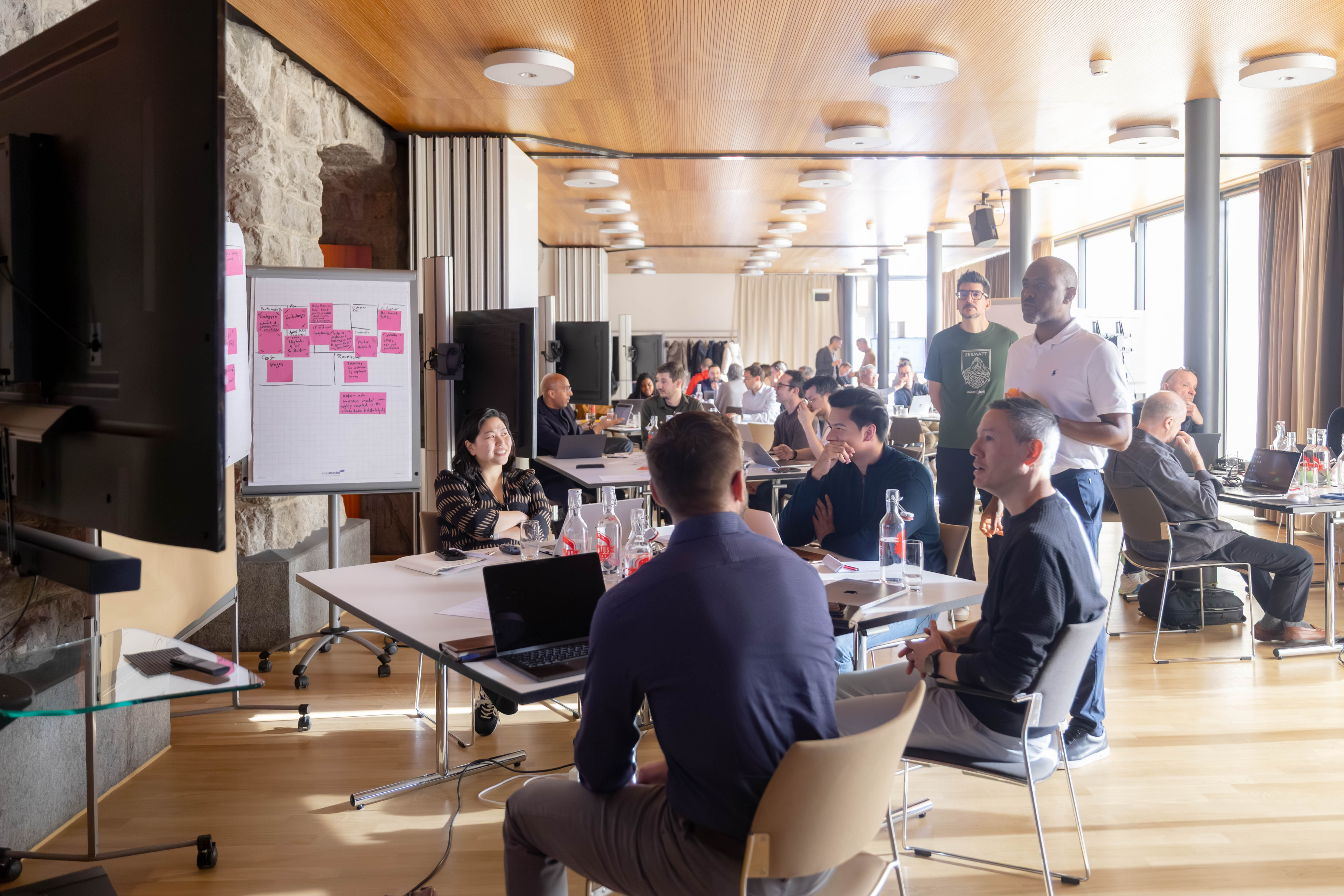
Teams spent a month performing pre-work, ensuring they didn't arrive with just "ideas," but with artifacts. They brought customer ecosystem maps, customer profiles, and "value scenes" (storyboards). During the symposium, they used these visuals to pitch. Because they had a shared language, the feedback was surgical. They weren't debating whether an idea was "good"; they were looking at a Business Model Canvas and identifying which assumptions needed to be tested first.

Alex emphasizes the importance of this shift: "This is not a joke: move from talk to concrete artifacts. Visuals improve communication and alignment significantly."

The workshop playbook: A story of transformation

Carol Hill shared the story of a London-based organisation that was struggling with what she calls "rabbit holes." Meetings would start with a goal, but quickly veer off into unrelated tangents. Nothing was being captured, and there was no roadmap for progress.

Strategyzer implemented a specific workshop playbook to change this culture. The rules were simple but strict:

  1. Digital-first capture: Even when meeting in person, every participant worked in a shared digital playbook. This ensured that every idea was captured as a "data object" that could be reused later, rather than a physical sticky note that gets thrown away. As Carol puts it, "The digital playbook is a shared space where everyone works simultaneously, even if they are in the same room."
  2. The "no blah blah" mechanic: The team used red Lego bricks. If someone started a tangent or "blah blah," anyone could hold up a brick to signal that the conversation was off-track.
  3. Progress over perfection: The goal was to move quickly and iterate. "The aim was progress, not perfection," Carol notes. By the end of the session, the team didn't just have a "good feeling"—they had a digital board with assigned owners, deadlines, and the very next small steps clearly defined.

The strategy playbook: Bringing order to complexity

Strategy conversations are notoriously difficult because they are often unstructured. Tendayi Viki points out that "Strategy conversations are unstructured and jump between high-level vision and implementation details, which leads nowhere."

To solve this, Tendayi recommends a specific sequence of tools:

  • Portfolio Map: Start by mapping your existing businesses to see where you are making money today and where you are at risk of disruption.
  • Business Model Canvas "epicentres": Use trigger questions (resource-driven, customer-driven, or finance-driven) to generate new strategic options.
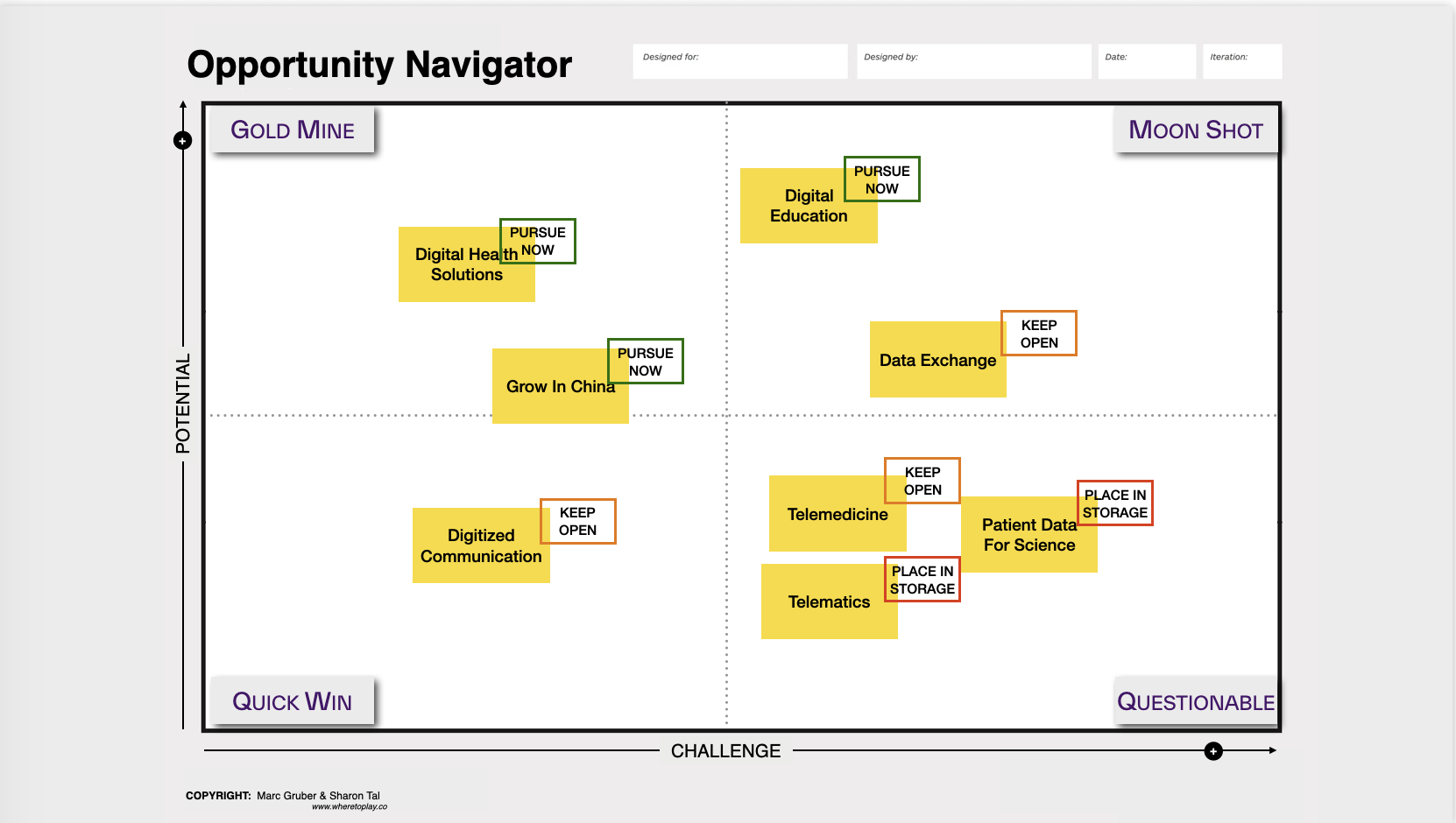
  • Opportunity Navigator: This tool allows you to map those options by their "potential" and "challenge." You then score them to decide what to pursue now, what to put in "storage," and what to explore later.

By following this playbook, the team stays focused on one level of granularity at a time. They aren't worrying about the color of a UI button while they are still trying to figure out if the business model is even viable.
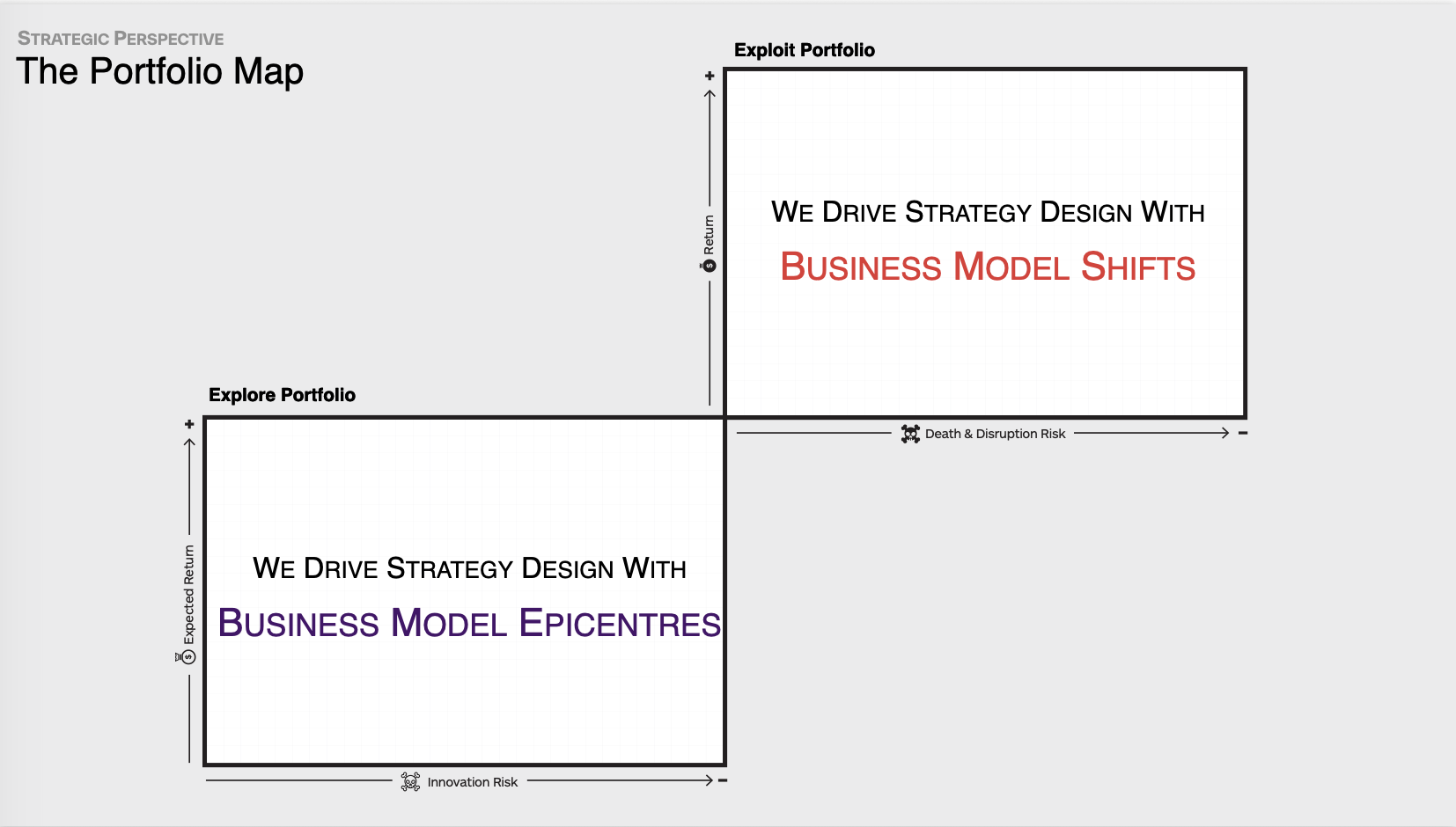
The Portfolio Map

The Opportunity Navigator

The facilitator's real job

If you are leading these sessions, your job is to manage the conversation's "granularity". When the team starts diving into implementation details too early, you must pull them back to the strategic level.

Tendayi explains that "Facilitation is about managing focus, levels of granularity, and energy." One way to do this is through structured feedback. Instead of asking "What do you think?", which invites "blah blah," use the Six Thinking Hats:

  • White Hat: What are the facts?
  • Yellow Hat: What are the benefits?
  • Black Hat: What are the risks?
  • Green Hat: What are the creative alternatives?

This keeps the team aligned on the type of thinking required at any given moment.
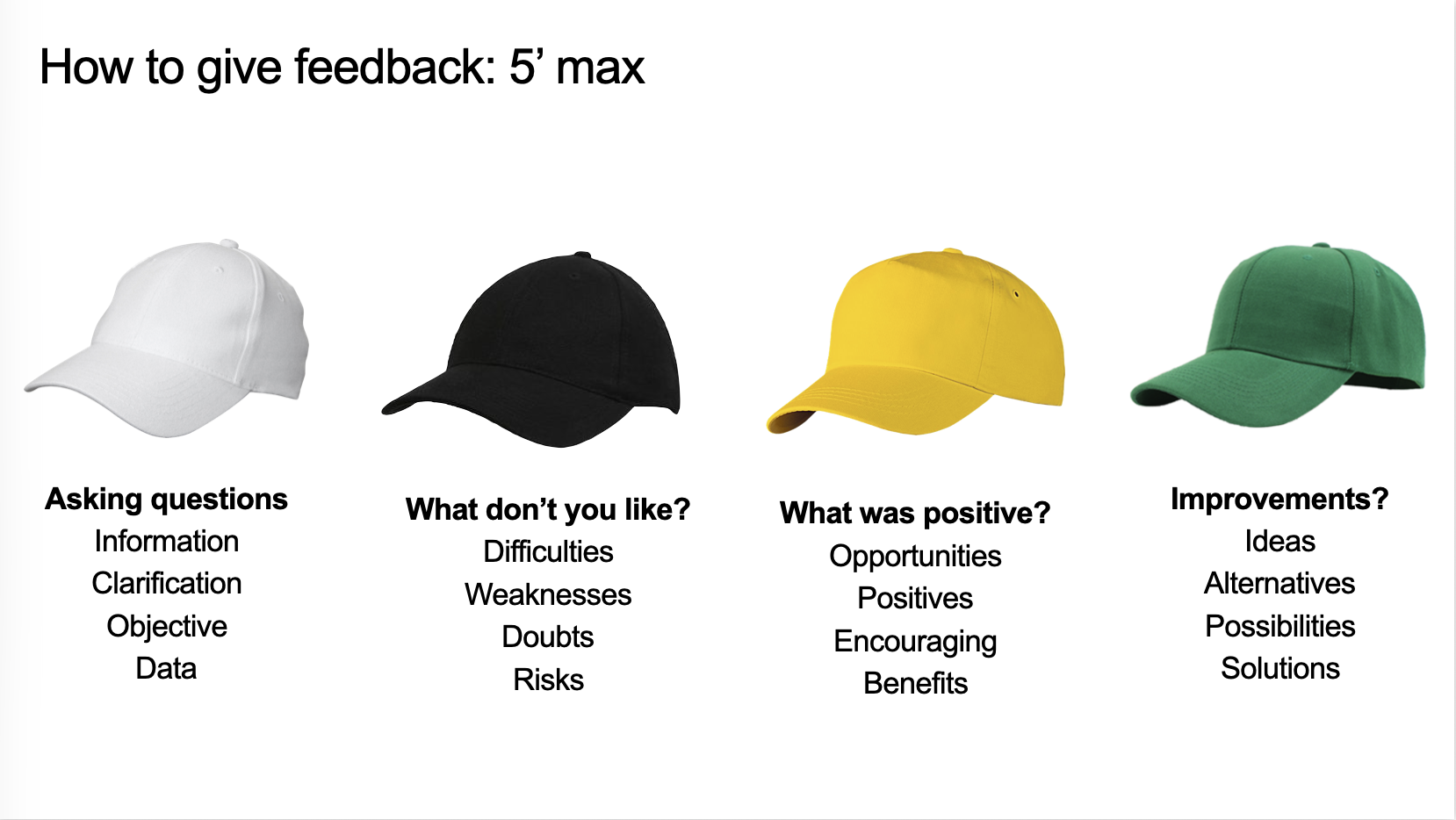
How to give high impact feedback in 5 minutes

Resolving leadership misalignment

A common problem surfaced during the session: the "missing strategy" trap. A leader might keep asking the team for "a strategy," while the team is convinced they already have one. This usually happens because they use different definitions and have no shared artifact to reference.

The solution is a visual alignment session. Stop talking about "the strategy" in the abstract. Instead, have the team create an artifact-based pitch. When you put a Business Model Canvas or a Portfolio Map on the table, it becomes immediately clear where the gaps are. You aren't arguing about opinions; you are looking at data.

Conclusion

Transforming your organisation’s meeting culture requires a shift in mindset: from seeing meetings as a necessary evil to seeing them as a designed process. By implementing structured playbooks, using visual tools to create artifacts, and focusing facilitation on granularity rather than charisma, you can ensure that every hour spent in a room drives your business forward. The trade-off is clear: you must give up the comfort of "open discussion" for the rigour of a structured process. Your next step is to choose one high-stakes meeting this month and replace the agenda with a visual playbook.

Would you like to dive deeper into these methods?
Download the slides

Ready to transform your high-stakes events and workshops?
Book a strategy workshop

related reads
No items found.

About the speakers

Dr. Alex Osterwalder
Entrepreneur, speaker, and business thinker

Co-founder of Strategyzer and creator of the Business Model Canvas. Alex has helped hundreds of organisations design and iterate their strategies using practical, visual tools that turn complex challenges into actionable moves.

Dr. Tendayi Viki
Author, speaker and advisor

Senior Partner at Strategyzer and author of multiple books on innovation and strategy. Tendayi regularly leads strategy workshops for Fortune 500 companies, helping leadership teams navigate disruption and make bold decisions with confidence

Carol Hill
Associate Partner and webinar host

Carol is an experienced innovation, strategy, and product development leader with a deep understanding of lean, design thinking, agile, and scrum methodologies. She has a proven track record of leading teams in complex organisations such as the LEGO Group and Pearson PLC to embed innovation programs, tools, and frameworks, and in developing innovative products during digital and organisational transformations. She is an Associate Partner at Strategyzer and is passionate about helping businesses and individuals build the confidence they need for ongoing growth and success.

by 
Dr. Alex Osterwalder
Dr. Tendayi Viki
Carol Hill
February 3, 2026
Share

Download your free copy of this whitepaper now

  • 1
  • 2
  • 3
Team member avatarTeam member avatarTeam member avatarTeam member avatarTeam member avatarTeam member avatarMattTeam member avatarTeam member avatarTeam member avatarTeam member avatarTeam member avatar
Let's talk
Want to make innovation work in your organization? Connect with us to explore practical solutions that fit your needs. We'll help you build ideas that deliver measurable results.
Thanks for your interest in our solutions. We will be in touch with you soon.
The playbooks for delivering world-class meetings
Webinars

The playbooks for delivering world-class meetings

The playbooks for delivering world-class meetings
Webinars

The playbooks for delivering world-class meetings

February 3, 2026
#
 min read
topics
No items found.

Most leadership teams spend their lives in meetings, yet they struggle to point to the concrete outcomes of those hours. When conversations remain abstract and unstructured, alignment is an illusion. To drive real change, organisations must move away from "open discussion" toward a structured, tool-based approach in which every session produces a tangible artifact. In this webinar wrap-up, we share the Strategyzer playbooks for designing and delivering world-class sessions that turn talk into action.

Executive summary:

Most leadership teams waste significant time in unstructured meetings that fail to produce concrete outputs. To solve this, leaders must adopt a "playbook" approach based on three pillars: visual tools, structured processes, and focused facilitation. By moving from abstract talk to tangible artifacts, such as the Business Model Canvas or Opportunity Navigator, teams create shared language and alignment. The core takeaway is to stop relying on facilitator charisma and start using digital-first, step-by-step processes to capture decisions in real time and ensure every session leads to a clear roadmap.

The high cost of unproductive talk

You know the feeling of leaving a three-hour workshop with a "vague sense of progress" but no clear idea of what happens next. This is the reality for most executives, who spend an average of 23 hours per week in meetings. The problem isn't a lack of talent; your team knows the business better than anyone. The issue is the lack of a system to capture that knowledge and turn it into data.

When a meeting is just a conversation, the loudest voice usually wins, and the most important insights are lost as soon as the room clears. Without a shared visual language, "alignment" is often just people nodding at different interpretations of the same word. To fix this, you need to change the rules of engagement. You need to stop talking and start building artifacts.

The three pillars of session design

World-class meetings are not the result of a "great facilitator" showing up and winging it. As Alex Osterwalder explains, "World-class meetings do not happen by accident. They are designed end to end." At Strategyzer, we view every high-stakes session through three specific lenses:

1. The right tools

Tools are the visual artifacts used to reach a desired outcome. This goes far beyond just "using a canvas." It includes:

  • Inquiry tools: Like the Business Model Canvas or Value Proposition Canvas, which help you design and explore.
  • Analytical tools: Like 2x2 matrices or the Opportunity Navigator, which help you score and prioritize.
  • Visual techniques: Using sticky notes, dot voting, and stack ranking to make invisible opinions visible.

As Alex notes, "Visual tools move groups from abstract talk to concrete artifacts, create shared understanding and language, enable broad participation, add structure without killing collaboration, and increase speed."

2. A structured process

A playbook is a defined sequence of exercises. It isn't just a template; it’s the "how-to" that guides a team from a blank page to a decision. For example, in a strategy session, you don’t just "talk about the future." You follow a sequence: map the current portfolio, generate options using "epicentres," score those options, and then select the next steps. This structure prevents the team from jumping between high-level vision and implementation details—a common failure mode.

3. Focused facilitation

Facilitation is about managing energy, focus, and levels of granularity. It is not about being the most charismatic person in the room. In fact, relying on charisma is a trap. Effective facilitation involves setting clear rules (like the "no blah blah" rule) and using structured feedback loops, such as De Bono’s Six Thinking Hats, to ensure every perspective is heard without the conversation devolving into a debate.

Case study: The Honeywell growth symposium

To see these pillars in action, consider the Honeywell Growth Symposium. The objective was to sharpen new business ideas and reduce investment risk through rigorous testing. This wasn't just a one-day event; it was a designed journey.

Teams spent a month performing pre-work, ensuring they didn't arrive with just "ideas," but with artifacts. They brought customer ecosystem maps, customer profiles, and "value scenes" (storyboards). During the symposium, they used these visuals to pitch. Because they had a shared language, the feedback was surgical. They weren't debating whether an idea was "good"; they were looking at a Business Model Canvas and identifying which assumptions needed to be tested first.

Alex emphasizes the importance of this shift: "This is not a joke: move from talk to concrete artifacts. Visuals improve communication and alignment significantly."

The workshop playbook: A story of transformation

Carol Hill shared the story of a London-based organisation that was struggling with what she calls "rabbit holes." Meetings would start with a goal, but quickly veer off into unrelated tangents. Nothing was being captured, and there was no roadmap for progress.

Strategyzer implemented a specific workshop playbook to change this culture. The rules were simple but strict:

  1. Digital-first capture: Even when meeting in person, every participant worked in a shared digital playbook. This ensured that every idea was captured as a "data object" that could be reused later, rather than a physical sticky note that gets thrown away. As Carol puts it, "The digital playbook is a shared space where everyone works simultaneously, even if they are in the same room."
  2. The "no blah blah" mechanic: The team used red Lego bricks. If someone started a tangent or "blah blah," anyone could hold up a brick to signal that the conversation was off-track.
  3. Progress over perfection: The goal was to move quickly and iterate. "The aim was progress, not perfection," Carol notes. By the end of the session, the team didn't just have a "good feeling"—they had a digital board with assigned owners, deadlines, and the very next small steps clearly defined.

The strategy playbook: Bringing order to complexity

Strategy conversations are notoriously difficult because they are often unstructured. Tendayi Viki points out that "Strategy conversations are unstructured and jump between high-level vision and implementation details, which leads nowhere."

To solve this, Tendayi recommends a specific sequence of tools:

  • Portfolio Map: Start by mapping your existing businesses to see where you are making money today and where you are at risk of disruption.
  • Business Model Canvas "epicentres": Use trigger questions (resource-driven, customer-driven, or finance-driven) to generate new strategic options.
  • Opportunity Navigator: This tool allows you to map those options by their "potential" and "challenge." You then score them to decide what to pursue now, what to put in "storage," and what to explore later.

By following this playbook, the team stays focused on one level of granularity at a time. They aren't worrying about the color of a UI button while they are still trying to figure out if the business model is even viable.

The Portfolio Map

The Opportunity Navigator

The facilitator's real job

If you are leading these sessions, your job is to manage the conversation's "granularity". When the team starts diving into implementation details too early, you must pull them back to the strategic level.

Tendayi explains that "Facilitation is about managing focus, levels of granularity, and energy." One way to do this is through structured feedback. Instead of asking "What do you think?", which invites "blah blah," use the Six Thinking Hats:

  • White Hat: What are the facts?
  • Yellow Hat: What are the benefits?
  • Black Hat: What are the risks?
  • Green Hat: What are the creative alternatives?

This keeps the team aligned on the type of thinking required at any given moment.

How to give high impact feedback in 5 minutes

Resolving leadership misalignment

A common problem surfaced during the session: the "missing strategy" trap. A leader might keep asking the team for "a strategy," while the team is convinced they already have one. This usually happens because they use different definitions and have no shared artifact to reference.

The solution is a visual alignment session. Stop talking about "the strategy" in the abstract. Instead, have the team create an artifact-based pitch. When you put a Business Model Canvas or a Portfolio Map on the table, it becomes immediately clear where the gaps are. You aren't arguing about opinions; you are looking at data.

Conclusion

Transforming your organisation’s meeting culture requires a shift in mindset: from seeing meetings as a necessary evil to seeing them as a designed process. By implementing structured playbooks, using visual tools to create artifacts, and focusing facilitation on granularity rather than charisma, you can ensure that every hour spent in a room drives your business forward. The trade-off is clear: you must give up the comfort of "open discussion" for the rigour of a structured process. Your next step is to choose one high-stakes meeting this month and replace the agenda with a visual playbook.

Would you like to dive deeper into these methods?
Download the slides

Ready to transform your high-stakes events and workshops?
Book a strategy workshop

related reads
Methods
How to design great workshops
Insights
Strategyzer master workshops: learn what it takes to create a world-class innovation engine
The playbooks for delivering world-class meetings

Most leadership teams spend their lives in meetings, yet they struggle to point to the concrete outcomes of those hours. When conversations remain abstract and unstructured, alignment is an illusion. To drive real change, organisations must move away from "open discussion" toward a structured, tool-based approach in which every session produces a tangible artifact. In this webinar wrap-up, we share the Strategyzer playbooks for designing and delivering world-class sessions that turn talk into action.

Thanks for your interest in 
The playbooks for delivering world-class meetings
ONLINE COURSe

Read more
Team member avatarTeam member avatarTeam member avatarTeam member avatarTeam member avatarTeam member avatarMattTeam member avatarTeam member avatarTeam member avatarTeam member avatarTeam member avatar
Let's talk
Want to make innovation work in your organization? Connect with us to explore practical solutions that fit your needs. We'll help you build ideas that deliver measurable results.
Thanks for your interest in our solutions. We will be in touch with you soon.