Executive summary
Many teams routinely mistake a polished business case for validation. They collect voice-of-customer research, build a spreadsheet, get board approval, and treat the result as proof the market wants the product. It isn't. It's a set of opinions with a financial model attached.
This session introduced a 0-to-5 evidence scale that makes the distinction objective. Levels 1 and 2 capture what people say. Levels 3, 4, and 5 capture what they do. The jump that matters is the one across that line, and it cannot be reached by doing more of what sits below it.
The clearest takeaway: evidence strength is a category, not a quantity. Five customer interviews and a million customer interviews score identically, because neither asked anyone to commit to anything.
"A spreadsheet is a fantasy made explicit. What you want is evidence that supports the spreadsheet."— Alex Osterwalder, Founder & CEO, Strategyzer
-
A team walks into an investment review with a validated business case. The spreadsheet is thorough. The market sizing is credible. Leadership asks how confident they are, and the answer is: very.
Then someone asks what the validation consists of. It turns out to be thirty conversations in which people said the idea sounded useful.
Osterwalder described sitting in senior leadership sessions the week before this webinar, looking at multi-billion-dollar growth projects, and seeing "validated business case" written next to "we still need to figure out the unique selling proposition." Both statements, on the same slide, about the same project.
Tendayi Viki, Senior Partner at Strategyzer, hit the same wall from a different direction — a young manager who kept insisting his business case was validated:
"My business case was approved by the board. As far as he was concerned, because the board approved it, he didn't need to run experiments anymore."— Tendayi Viki
Kurt Bostelaar's summary of the logic: market-ready, because the board said so.
This is the default state in most organizations, and it persists because nobody has an objective way to say otherwise. Here's the system Strategyzer built to fix that.
1. Volume is not strength
Start with the mistake that costs the most.
If you have five customer interviews with no solution in front of the customer, that's a 1. If you have a hundred, it's a 1. If you have a thousand, it's still a 1. Nothing about the count changes what kind of knowledge you hold — you have opinions, gathered in a low-stakes setting, about something the customer never had to react to or commit to.
Osterwalder was blunt about the arithmetic: the strength of your evidence doesn't increase just because you did more of the same thing. There's no commitment in any of it.
This is the single most common misreading of customer research, and it survives because volume feels like rigor. Thirty interviews sound more serious than three. It isn't - not on this scale.
Watch-out: Teams present the amount of evidence when asked about the quality of it. When someone says "we've done extensive VOC," the useful follow-up isn't how much, it's what the customer had to do.
2. The say–do line is where confidence starts
The scale runs from 0 to 5, and its structure is simple enough to hold in your head.
- 0 — Not real evidence. Business plans, spreadsheets, high-level market research. A direction, not a finding.
- 1 — What people say. Discovery interviews, surveys. Opinion, low stakes, lab context.
- 2 — Reaction to artifacts. You put something tangible in front of them — a data sheet, a brochure, a mock-up — and capture the response. Still what they say, but with less fuzziness.
- 3 — Low-stakes action. They do something small, unprompted. A landing page with a call to action; signing up for a sales call you didn't ask them to take.
- 4 — Meaningful-stakes action. Real skin in the game. A signed letter of intent, a full-day co-creation workshop, a pre-sale.
- 5 — Markets and invisible experiments. Real-world behavior, where the customer doesn't know they're in an experiment at all.
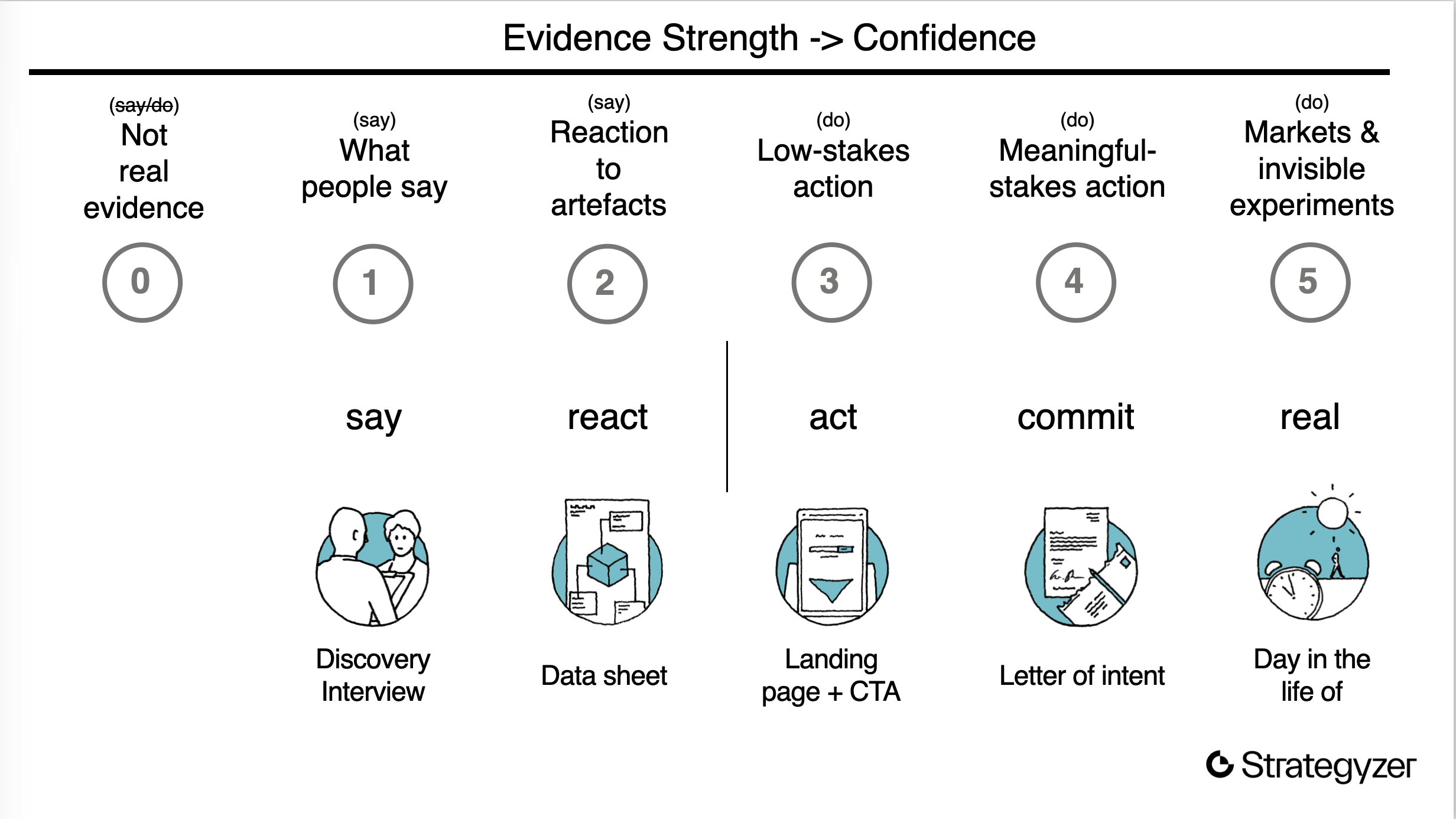
The deck compresses these into five verbs: say, react, act, commit, real. The vertical line sits between 2 and 3. Everything left of it is what people tell you. Everything right of it is what they did.
Osterwalder shared the naming history, which is more instructive than it sounds:
"We used to call it weak evidence. Then we realized no team is ever going to show weak evidence. But when you call it light, they might actually be honest."— Alex Osterwalder
Watch-out: Ask which segment the evidence came from. A team saying customers are willing to pay may have interviewed users rather than decision-makers — different people, different answers, and a distinction that quietly determines whether the evidence means anything.
3. You are scoring aspects, not the idea
The objection arrives immediately: this doesn't prove the whole idea. Correct — and beside the point. You're providing evidence for aspects of an idea. Evidence for the customer, evidence for the solution, evidence for willingness to pay. Evidence that proves everything would require building the thing.
Two examples from the session make the point better than the framework does.
American Family Insurance took a marketing brochure for farm insurance to a farming convention. The brochure was real; the product didn't exist. At the bottom was a call to action: email us, call us. 15% responded and followed up, and it resonated more with cattle farmers than corn farmers — so they pivoted the value proposition and adapted the marketing.
That's a 3. Not for the idea, for desirability. There's nothing in it about viability.
Fireflies.ai went further with less. The founders were coders who declined to code the solution before testing it. They launched a site with a price, and when customers booked a meeting, the two co-founders joined silently, cameras off, and sent a summary afterwards. As co-founder and CTO Sam Udotong put it, they charged $100 a month for an AI that was really just two guys surviving on pizza.
Zero feasibility evidence — humans don't scale. But strong desirability and viability evidence: people paid, and they didn't cancel after the first summaries arrived. That's a Wizard of Oz experiment, and it's a 5.
Watch-out: A 5 on one dimension is not a 5 on the project. You can hold real-market evidence on desirability while sitting at 0 on feasibility. Calibration also shifts by context — one sale into a market of 100 companies is strong B2B evidence; one sale into a consumer market of five million is not.
4. Where the scale came from: 12 projects, half the budget
The framework started as a constraint, not a theory.
Viki was working with a paint manufacturer whose innovation lab had just had its budget cut by 50%. There were twelve projects, and they had to choose five.
"You're not allowed to choose your favorite projects. We have to find the projects that are closest to success."— Tendayi Viki
The scorecard didn't exist yet, so he wrote desirability, feasibility and viability on the wall and went project by project, asking for scores out of 10.
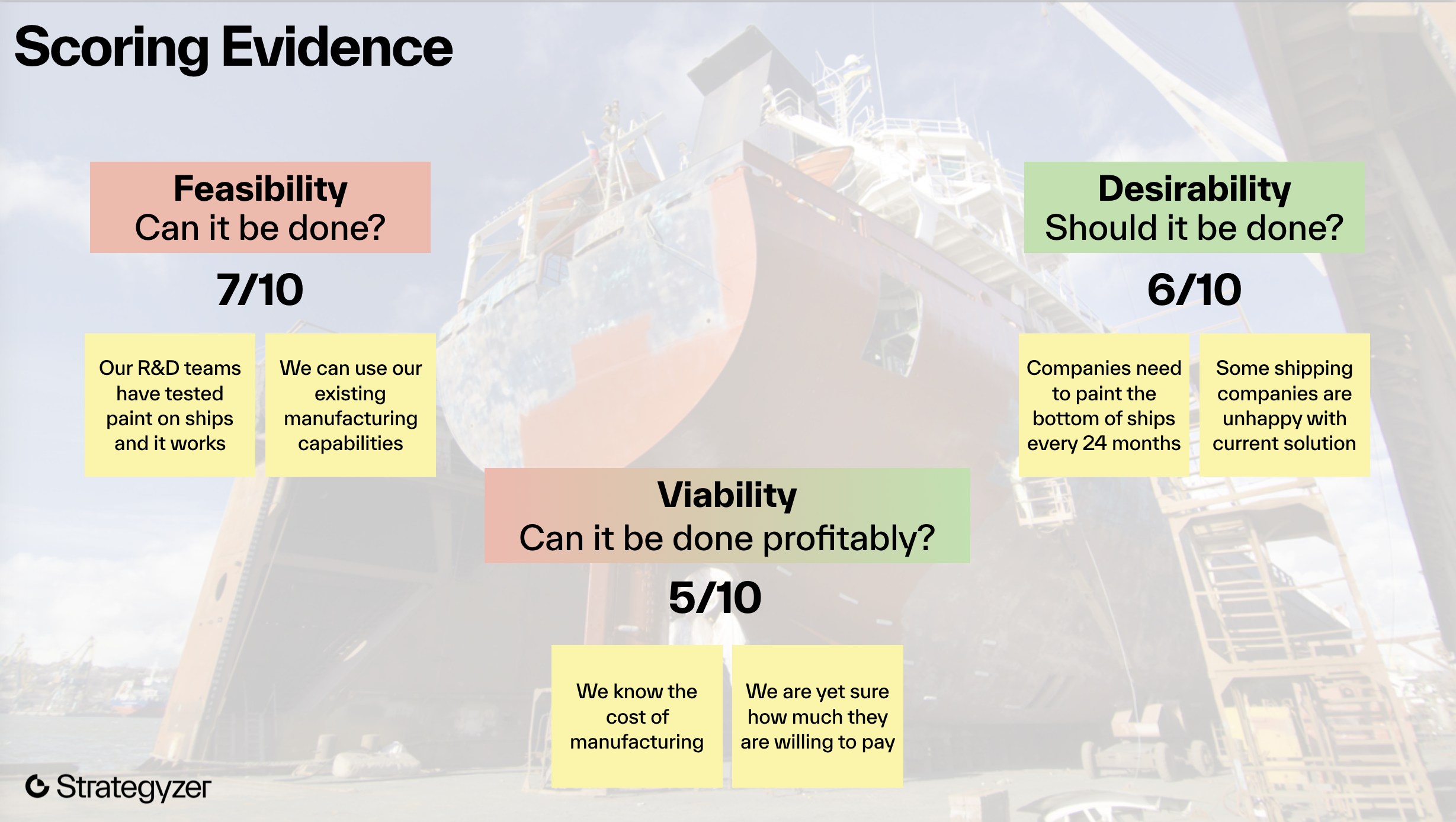
One project was ship-bottom paint — a genuinely attractive business, since commercial vessels are dry-docked and repainted every 24 to 36 months, making it close to recurring revenue. The team scored feasibility 7, desirability 6, viability 5.
Then Viki asked how they knew. R&D had tested the paint; existing manufacturing could produce it. Companies need to repaint on a cycle, and some are unhappy with their current supplier. Cost of manufacture, known. Willingness to pay — not known.
The viability score came down to a 4, in the room, because one of the two supporting claims turned out to be an assumption.
Two insights came out of that engagement and became the work: scoring out of 10 invites teams to pick high numbers, so it needed to be more objective — and it needed to work without a coach in the room.
5. Without a coach in the room, everyone scores themselves a 5
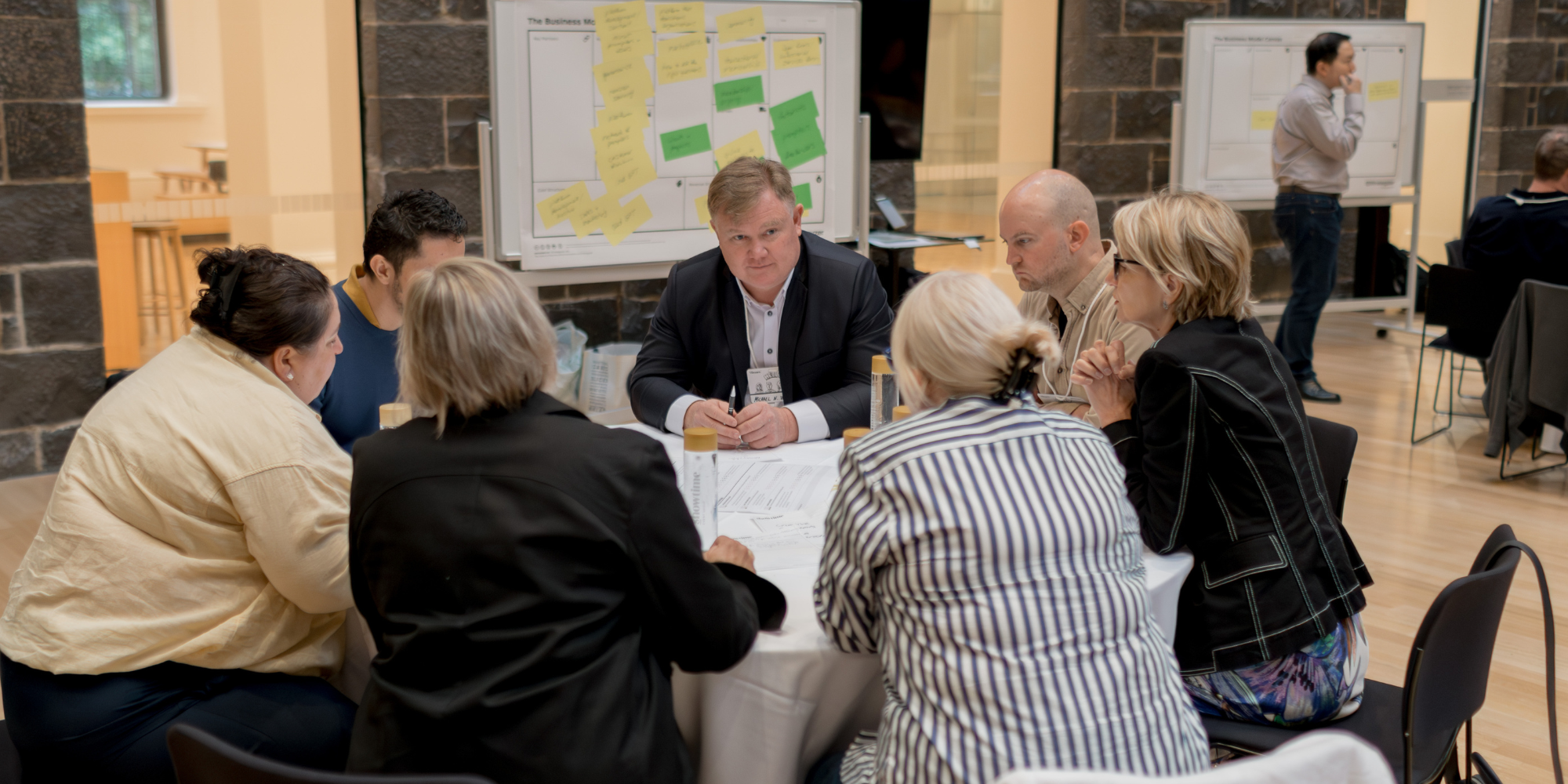
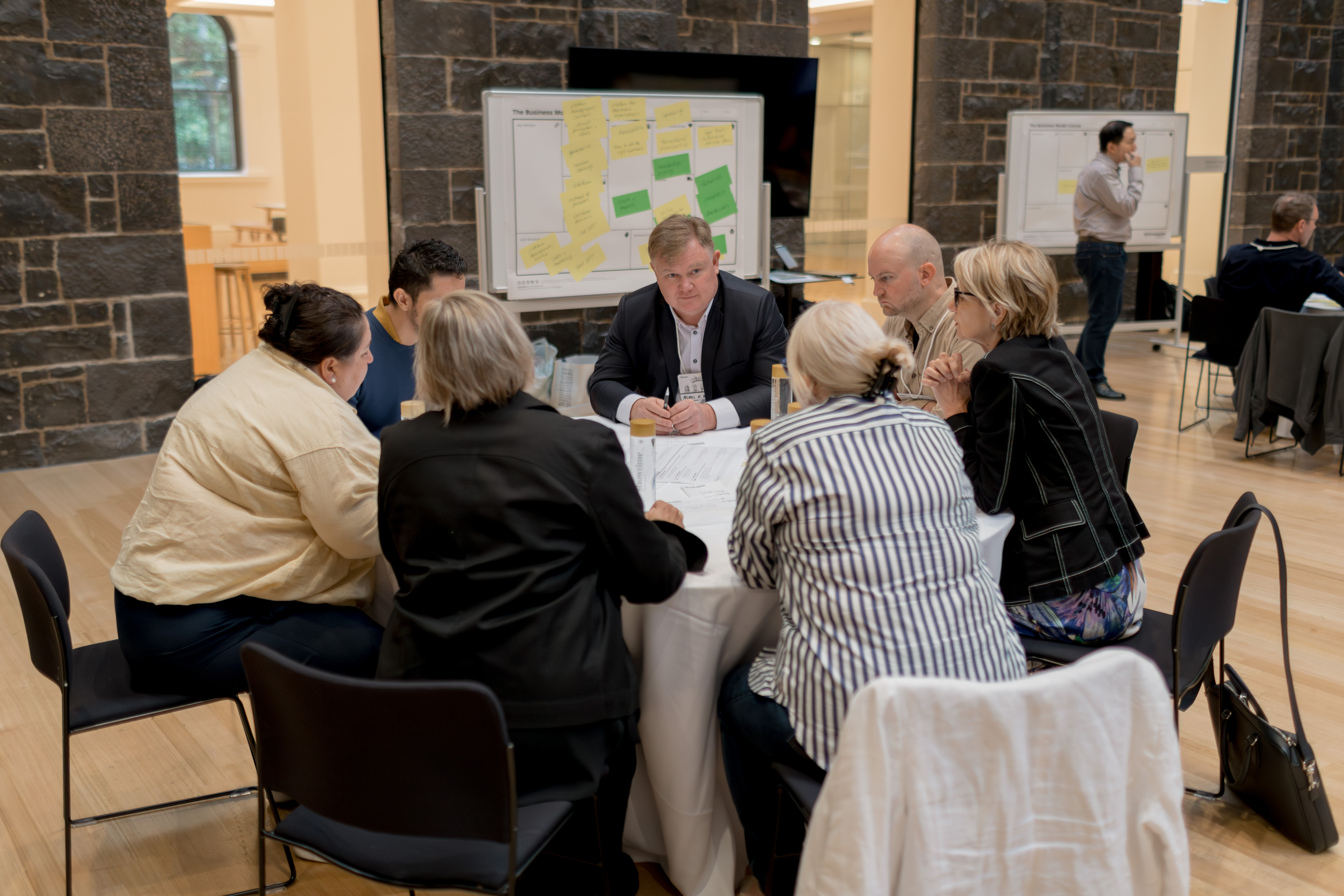
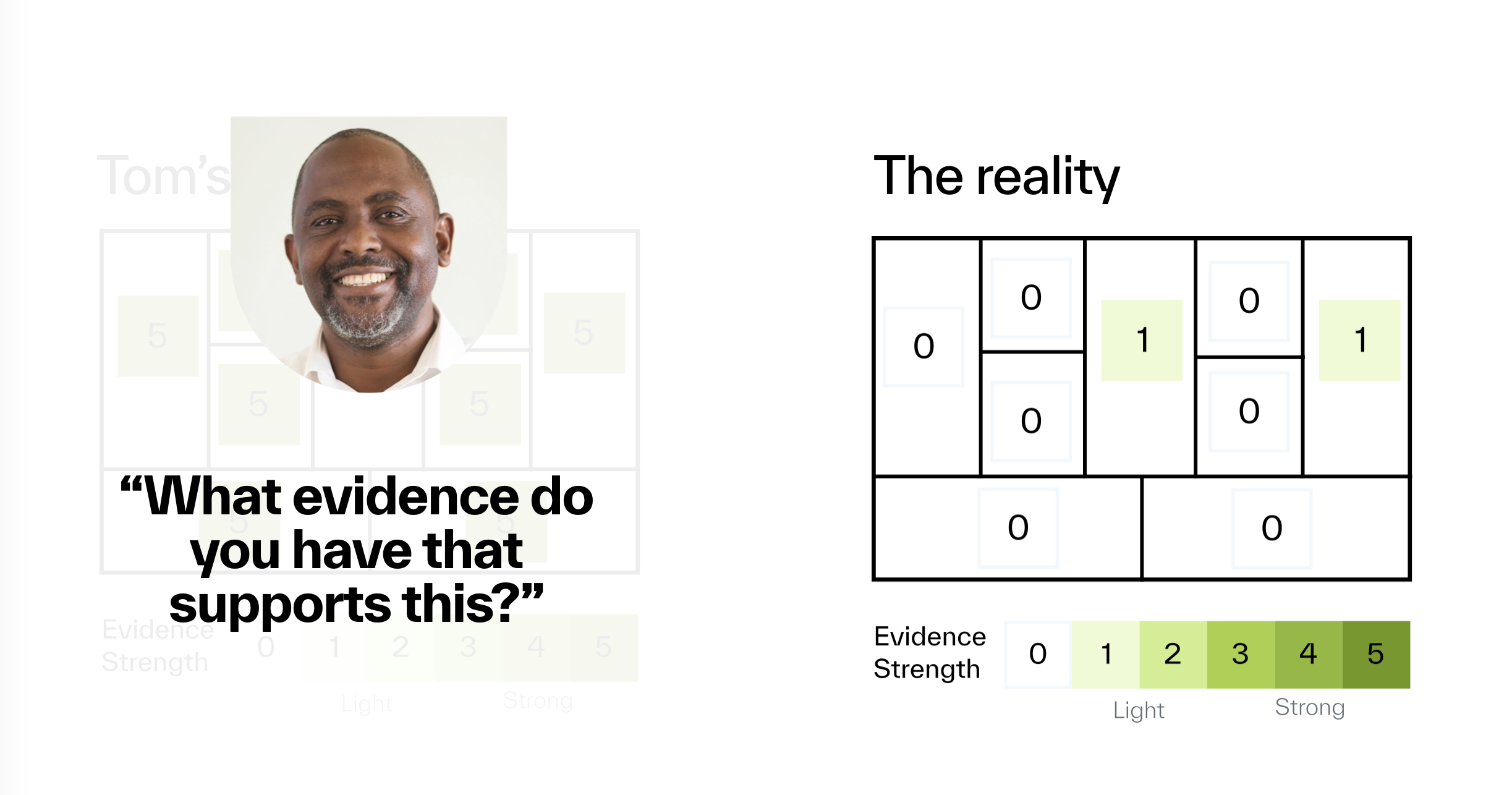
Bostelaar, who designed the playbook, put up a business model canvas belonging to a fictionalized team lead. Every block scored 5. Ready to go, certain of success.
Then the real scores: mostly 0s, with a couple of 1s.
The gap isn't dishonesty. It's the absence of a shared language and something concrete to point at. What closes it is a single question, asked of every sticky note on the canvas: what evidence do you have that supports this?
Bostelaar has tested this with business leaders in Atlanta. Even when scoring is introduced, people drift toward 5 — until they're made to write the evidence down.
He also has a personal stake in it:
"If I had spent three hours with this playbook, it would have saved me three years."— Kurt Bostelaar, Playbook Designer, Strategyzer
Three years on a startup that wasn't working, before a pivot took it from no revenue to six figures — driven by exactly the kind of insight this scoring surfaces in an afternoon.
Osterwalder's response was to widen it: don't waste time on ideas when you can score how close you are. Companies waste millions, sometimes billions, on projects with zero evidence behind them.
"It doesn't matter if it's a $1 million or a $1 billion business — it is the same idea of evidence."— Alex Osterwalder
Notably, he doesn't much care whether a given item lands on a 3 or a 4. What matters is that the team and the leadership are arguing about the quality of the evidence rather than the quality of the story.
6. What a playbook does that a course doesn't
The second problem was distribution. Learning management systems teach you to watch a video and pass a quiz, which demonstrates that you can pass a quiz.
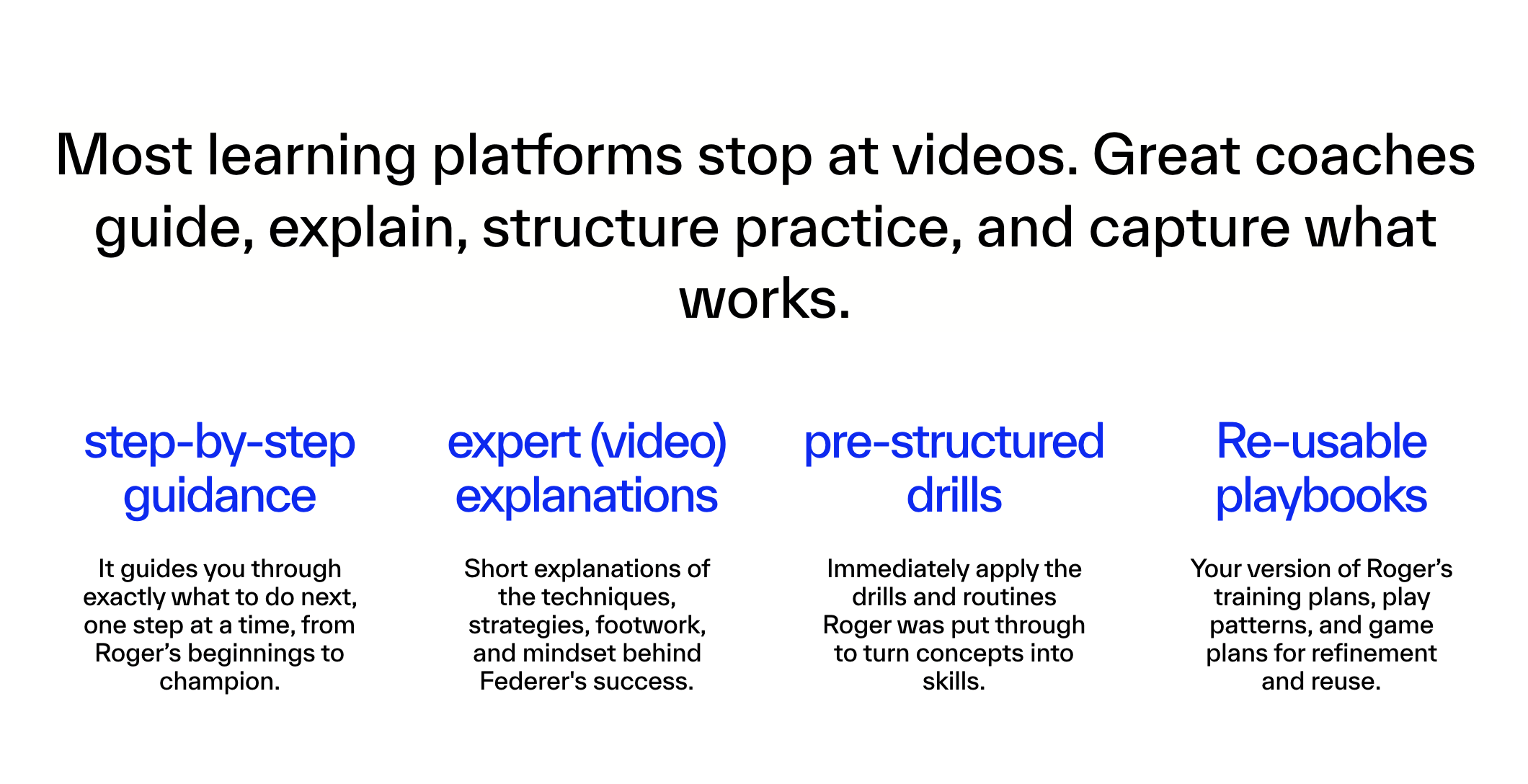
Osterwalder used Roger Federer to frame the alternative. Federer credits his first coach, Peter Carter, with setting the foundation for everything he later refined. So: imagine Federer's coaching playbook were available to everyone. What would it need?
Four things, per the deck: step-by-step guidance on what to do next; short expert explanations of the concepts; pre-structured drills that turn concepts into skills; and reusable playbooks you can run again.
Map that onto business and you get the Strategyzer playbook format. The featured one — How market ready is your project? — packages Viki's scoring approach into 13 short videos and 8 workspace activities, moving from navigating risk and uncertainty, through mapping your idea, into scoring evidence block by block: do they want the value proposition, can we acquire and retain customers, can we deliver at scale, and will it be profitable.
Watch-out: The activities look deceptively simple. Filling in a scorecard takes minutes; being honest while you do it is the hard part, and that's what the structure is for.
Pressure-test your own project
Take your current project and run it through this:
- For each block of your business model, what is the actual evidence — written down, not remembered?
- Which side of the say–do line does each piece sit on?
- Did the customer do something unprompted, or did they respond to you asking?
- Did the evidence come from users or from decision-makers?
- Where are you counting volume as though it were strength?
- Which aspect is weakest — desirability, feasibility or viability — and what's the lightest experiment that would move it one level?
- If leadership asked "what evidence supports this?" for every sticky note, how many would survive?
Conclusion
The gap between a validated business case and a market-ready project is not a gap in effort. Most teams that score themselves a 5 have worked hard; they've done the interviews, built the model, and won the approval. The gap is that none of that work required a customer to do anything.
An objective scale is uncomfortable precisely because it's objective. A team that discovers it's sitting at 1 across the board hasn't lost anything — it's found out now rather than three years from now. And the fix is usually cheaper than the research already done: one landing page, one letter of intent, one silent founder on a call.
Map your current project against the 0–5 scale this week. Score every block, write the evidence next to it, and see how much survives the question.
Download the slides. The full deck includes the evidence scale, the paint manufacturer scoring, and the innovation project scorecard referenced throughout the session.
Get the playbook subscription. How market ready is your project? packages Tendayi Viki's scoring method into 13 videos and 8 workspace activities, so your team can run it without a coach in the room. One subscription at $299 includes the whole library, with a 14-day money-back guarantee. Use code IMPACT20 for 20% off before 30 September 2026.