.png)
Executive summary
In a live product showcase, Alex Osterwalder, Ashley Underwood, and Olaide Kaffo walked through how Strategyzer Playbooks help teams move from concept to output in hours, not weeks. The webinar argued that books, training, and generic templates rarely produce results on their own. Audience poll results confirmed the biggest barrier is "teams stuck in discussion instead of making decisions." The takeaway for leaders: structure, time-boxing, and reusable data objects matter more than the framework itself. Start with one short playbook, one team, one real decision.
Introduction
You have the frameworks. Your team has done the training. You may have even run the Business Model Canvas or Value Proposition Canvas many times before. And yet – sessions drift. Discussion loops. The output feels thin by the time people get back to their inboxes.
You are not alone. When Alex Osterwalder asked the live webinar audience what most prevents teams from getting results, the top answer was clear: teams get stuck in discussion instead of making decisions.
Ashley Underwood named it plainly. "I design workshops that are structured, but within 15 minutes they've been derailed by a competing priority we didn't know about." That is the real constraint strategy and innovation leaders work against – not a lack of tools, but a lack of discipline built into the session itself.
This post distils the showcase into a practical view of what playbooks are, how they differ from books and templates, and how to choose the right one for the session you need to run next.
Why frameworks alone rarely deliver results
Strategyzer spent 15 years watching teams apply the Business Model Canvas, the Value Proposition Canvas, and related tools. The pattern was consistent.
Books, training, and e-learning rarely lead to strong, fast results. People struggle to turn concepts into effective workshops and sprints. Doing it themselves takes time and often leads to weak outcomes. Hiring consultants works – but it is expensive and hard to scale.
As Alex put it during the showcase: "We're not smarter, we've just failed a lot more." That experience compounds. What it produces is not a new concept, but a new format: a guided sequence that tells a team exactly what to do, in what order, using which visual tool.
The shift is from learning-to-apply to applying-immediately.
What a playbook actually is
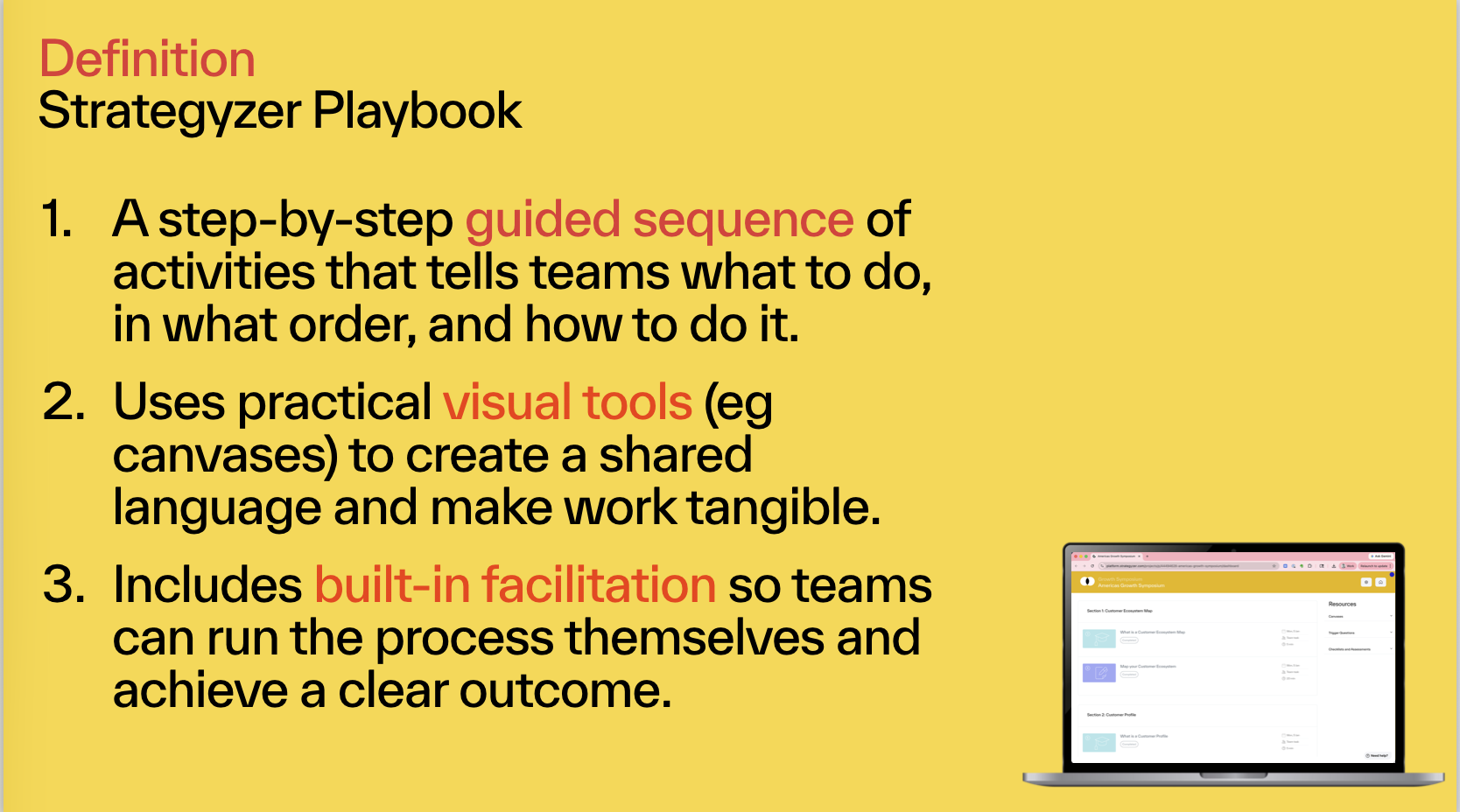
Strategyzer defines a playbook with three elements:
- A step-by-step guided sequence of activities that tells teams what to do, in what order, and how to do it.
- Practical visual tools, such as canvases, that create a shared language and make the work tangible.
- Built-in facilitation, so teams can run the process themselves and reach a clear outcome – with or without a coach in the room.
A single playbook can be as short as a one-hour meeting or as long as a multi-week sprint. That range matters, because time is almost always the constraint. You rarely get the half-day you want.
A Honeywell leader told Alex after a workshop: "Alex, we've been using this for a long time, but we didn't get out of it what we're getting out of it now with your playbooks." Same canvas. Different container. Different outcome.
How to choose the right playbook
Ashley walked through the Playbook Library live. Three filters matter most when you are picking one for a real session.
- Time. Do you need impact in an hour? Have you got buy-in for a half-day? Is this a multi-week project? Filter by duration first – it is the constraint that most often gets ignored.
- Expert level. Most real teams are mixed. A beginner playbook walks participants through the concepts before the exercises. An expert playbook jumps straight into mapping. Pick for the least experienced people in the room.
- Tool. Search by what you actually want to produce – a business model, a value proposition, a customer profile – rather than by the name of the session you have on the calendar.
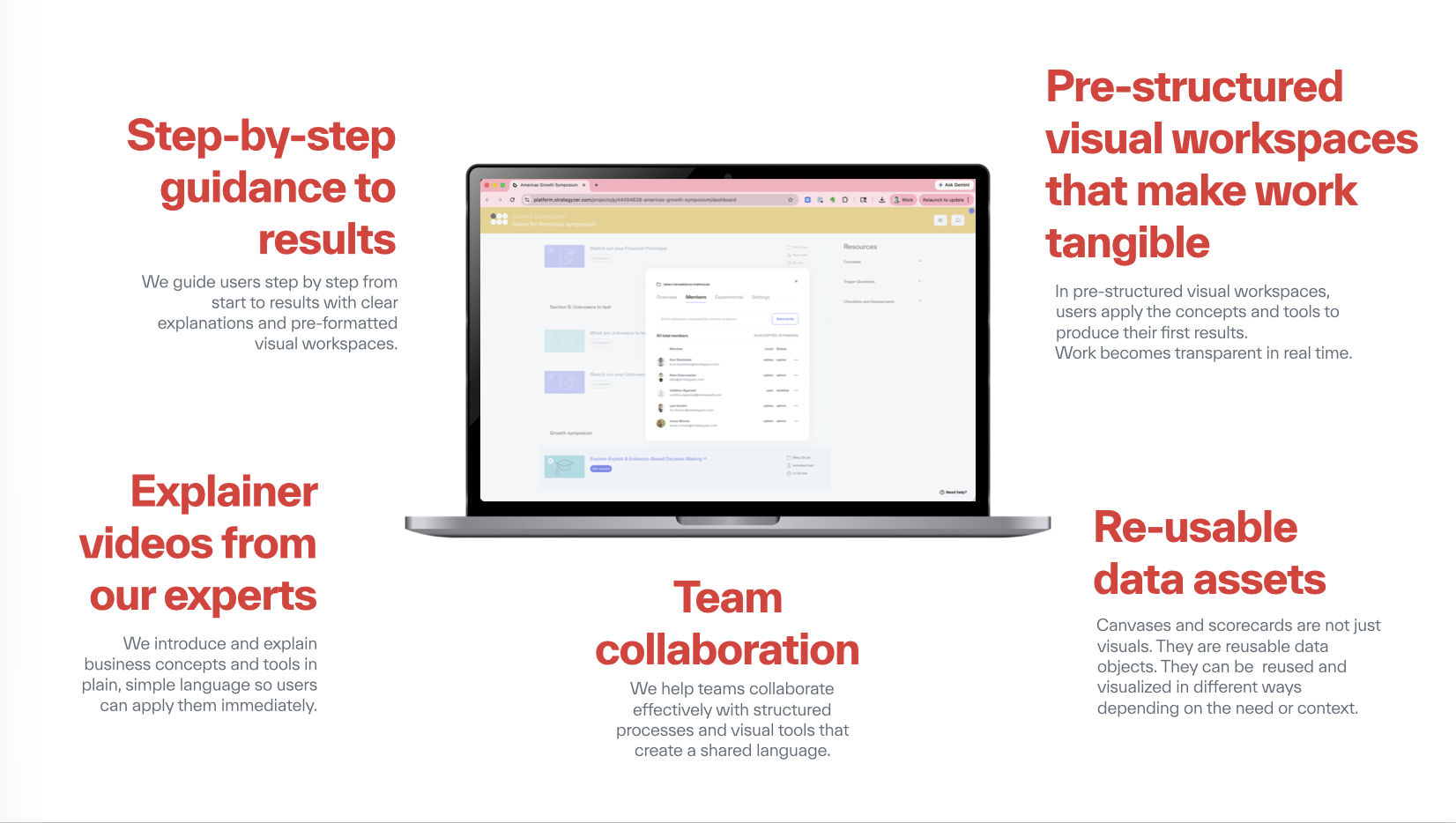
A practical example from the showcase: one hour, limited buy-in, a team new to the tool. The fit is "Map Out Your Business Model with B2C Examples." Pre-configured workspaces, a short explainer video, and ready-to-run exercises. No template-hunting, no Miro board to rebuild from memory.
The feature most teams miss: reusable data assets
This was the feature Alex said most subscribers do not discover for months.
Every visual object on the platform – a customer profile, a canvas, a sticky note – is also a data object. When you update it in one workspace, it updates everywhere it is referenced.
Here is what that looked like at Honeywell. Teams built a customer profile during pre-work. They reused that same profile when zooming into jobs, pains, and gains. They reused it again when mapping value propositions and differentiation. And again when preparing their first pitch to leadership.
The compounding effect is real. Work is never lost. People do not start from scratch in each exercise. And when a team member refines a customer profile mid-session, every downstream artefact updates with it.
For leaders running multiple workshops across a quarter, this is the difference between one-off sessions and a connected strategy workstream.
Where AI fits – and where it doesn't
AI featured throughout the showcase, but with a clear boundary. Alex was direct: "There's not a chance an LLM is going to replace the facilitated playbooks we run there. Some work just needs human facilitation."
Where AI does help, Strategyzer has built it in:
- AI Builder generates suggested Jobs, Pains, and Gains from a short description of your idea. It removes the blank canvas problem – the moment teams freeze because they do not know where to start.
- Mini Coach reviews what a team has mapped and asks sharper questions. It surfaces assumptions the team did not notice.
- Custom canvases let you build your own visual tool – a customer journey map, for example – and treat it as a reusable data asset alongside Strategyzer's core canvases.
Alex's framing: "Human in the loop is key." AI accelerates the blank page. It does not replace the team conversation that turns inputs into decisions.
Enterprise in practice: The Honeywell Growth Symposium
Strategyzer has run the Honeywell Growth Symposium four times – across North America, Europe, China, and India. Between 10 and 14 teams pitch growth ideas to senior leadership at each event.
The playbook structure had two objectives: get each team to make explicit how they create value for the customer and for Honeywell, and get them to present the evidence behind their ideas so leaders could judge its strength.
The sequence looked like this:
- Pre-work (self-serve on the platform): customer ecosystem → customer profile → value scene → business model → financial prototype → known unknowns.
- One office hour per week shared between a Honeywell and a Strategyzer team member.
- One-day physical workshop with Strategyzer facilitators to run the final pitch preparation and leadership review.
The lesson for any enterprise team: the workshop day is not where most of the value is created. The value comes from doing the preparation in a structured, visual format beforehand, so the room-time is spent on decisions, not set-up.
One detail worth calling out. At the event, Alex required teams to present directly from the platform rather than export to slides. His reasoning: "As soon as they move to slides, font sizes drop to 3.2 and nothing is clear." The structure of the canvas protects the clarity of the thinking.
Want to know more about Honeywell use Strategyzer playbooks, watch our webinar with them.

Common watch-outs
From the poll results and the speakers' experience, four failure modes came up repeatedly:
- Treating a playbook like an LMS course. Playbooks are designed for teams of three to five people working together, not for solo learning. Most of the value is in the team conversation the structure forces.
- Picking the wrong expert level. A team of leaders who have never seen a canvas will stall in an expert playbook. A team that uses the canvas weekly will be bored by a beginner one. Match the playbook to the least experienced person in the room.
- Skipping pre-work. The Honeywell case works because teams arrive with artefacts already built. Pre-work is not homework – it is what makes the live session possible.
- Underestimating the concepts gap. Olaide named this from the poll: "Lack of understanding of key concepts and tools is something very prevailing." Even experienced teams often have one or two members who need the concept primer. Build it in.
Conclusion
The shift the speakers are advocating is simple but easy to get wrong in practice. Frameworks are necessary but not sufficient. What moves a team from discussion to decision is the container around the framework: the sequence, the time-boxing, the pre-structured workspace, and the ability to reuse what the team has already built.
There is a trade-off worth naming. Playbooks remove optionality on purpose. You give up some of the freedom to improvise in exchange for getting to an output. For most teams most of the time, that is the right trade. But it only works if the playbook fits the session and the people in it.
The next step is small. Pick one short playbook, one real decision your team is facing, and one hour on the calendar. Run it. Then decide what to do next.
Want the full deck from the showcase? Download the slide.
If your team runs workshops, sprints, or strategy offsites, the Strategyzer Playbook Library gives you ready-to-run playbooks your team can use on real projects from day one. Explore the library or talk to us about how playbooks fit into your team's way of working. Learn more.