The value proposition canvas on a Remarkable tablet

What great value propositions look like

Dr. Alex Osterwalder
Dr. Tendayi Viki
Carol Hill
May 8, 2026
#
 min read
topics
No items found.

A great value proposition is not the same as a great product or technology. It is what happens when products and services are designed to address the specific jobs, pains, and gains of a clearly defined customer segment, and differentiated along the dimensions those customers actually care about. This wrap-up of Strategyzer's webinar with Alex Osterwalder, Tendayi Viki, and Carol Hill unpacks what separates value propositions that win from those that bomb.

Watch the full webinar

Executive summary

Most value propositions fail for one of two reasons: the team confused a cool product with real value creation, or it differentiated against competitor features instead of customer-perceived differences. Using winners (Nintendo Wii, Crocs, Stanley Quencher, Too Good To Go) and failures (Juicero, Segway, Quibi, General Magic), the speakers showed that great value propositions create value for a specific segment and use a Blue Ocean lens to eliminate, reduce, raise, and create on the dimensions that matter. The next step: pressure-test your value proposition against real customer jobs, pains, and gains.

"You don't perform well on everything, but you perform well on what matters to your customer segment."
— Alex Osterwalder

Two principles every great value proposition shares

Tendayi Viki opened the session by setting two non-negotiable criteria.

The first principle is value creation. A value proposition is not a product or a technology. It is the combination of what you build and the value that combination creates for a specific segment of customers. As Viki put it, "having a cool technology is not the same thing as having a value proposition." This matters more than ever in an environment where AI is reshaping product roadmaps. New is not the same as valuable.

The second principle is differentiation through the customer's eyes. Most teams differentiate by looking at competitors and asking how they can be different. That is the wrong starting point. The question is whether the customer can perceive the difference, and whether the difference maps to jobs, pains, and gains they actually care about.

To make this practical, the session leaned on the Blue Ocean Strategy four-actions framework: eliminate, reduce, raise, create. Apply each action to the dimensions customers care about, not to the feature list your competitors are racing on.
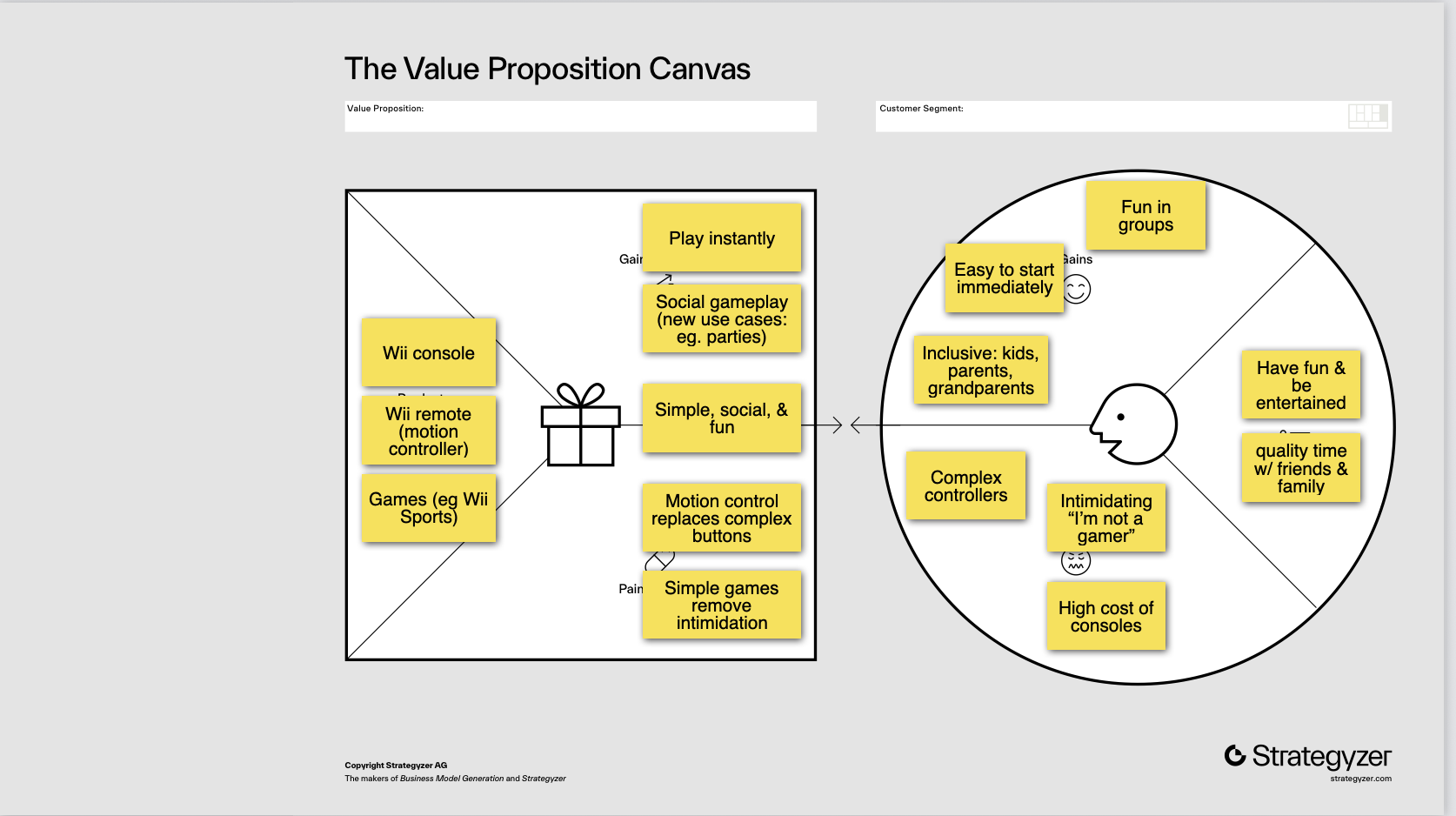
The Value Proposition Canvas

How great value propositions get built: the Wii pattern

Alex Osterwalder used the Nintendo Wii as a case in point. The Wii out-competed the Xbox and PlayStation with inferior hardware. That is the part that should make every product team pause.

Nintendo did not target hardcore gamers. They targeted casual gamers. For that segment, the jobs to be done were simple: have fun, spend quality time with friends and family. The pains were equally clear: complex controllers, intimidating learning curves ("I'm not a gamer"), and the high cost of consoles.

Mapped through the four-actions framework, the strategic moves become obvious:

  • Eliminated: the hardcore gamer focus, the performance arms race
  • Reduced: hardware specs, game development complexity, console price
  • Raised: accessibility, social and group play
  • Created: motion control, casual-gamer focus, gaming as a social activity, new use cases (parties, fitness)

The strategic insight, in Osterwalder's framing: Nintendo did not build a better console. They built a different definition of gaming. On the dimensions that mattered to casual gamers — accessibility, fun, and social experience — the Wii was clearly differentiated. On graphics and performance, it lost on purpose.

That is what customer-perceived differentiation looks like in practice.
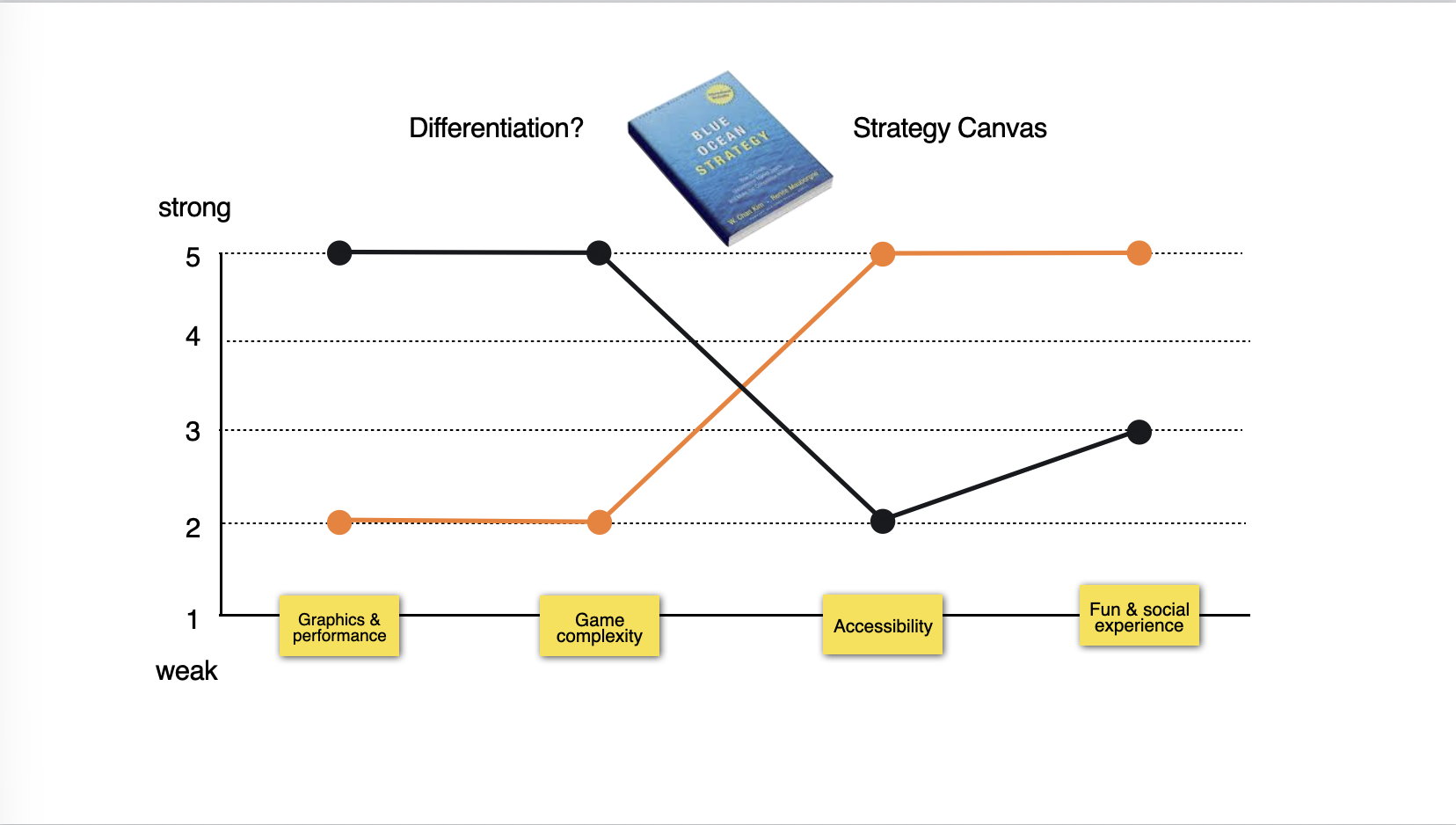
The Differenciation Strategy Canvas from Blue Ocean Strategy

Patterns from value propositions that bombed

The session worked through five high-profile failures, each illustrating a different failure mode.

Juicero (pain smaller than the price). A 699 dollar machine to press juice bags that customers could squeeze by hand. The pain it relieved was nowhere near the price tag. Compare it to Nespresso, which addressed a real job (espresso at home) and a real pain (the messy, inconsistent process of making one) at a price point customers accepted.

Segway (good-enough alternatives). Walking, bikes, public transport, and cars were good enough on cost, social comfort, and convenience. Segway only led on convenience for short trips. The next best alternative is rarely a direct competitor; it is whatever the customer is already doing.

General Magic (too early). A pocket internet device in 1994. Most people worked in offices, mobile work culture barely existed, and email adoption was still limited. The job they targeted — stay connected and productive anywhere — was emerging, not present. Thirteen years later, the iPhone met a world that was ready.

Iridium (too late and too expensive). Satellite phones that took eleven years to launch, by which time mass-market cell phones had taken over. The price of 3,000 dollars made it irrelevant at launch.

Quibi (no differentiation). Premium short-form video for mobile, backed by Meg Whitman and Jeffrey Katzenberg. Money was not the constraint. The alternatives — YouTube, Netflix, TikTok, Instagram — were too good and too entrenched. 1.7 billion dollars later, Quibi shut down within the year.

The watch-out across all five: not one of them lacked capital, talent, or technology. They lacked a value proposition that survived contact with the customer's reality.

When the differentiation lives in the business model

Carol Hill's case study on Too Good To Go showed that differentiation does not always live in the product. Sometimes it lives in the business model.

Too Good To Go targets urban, value-conscious consumers who want affordable food, local discovery, and a way to act sustainably without much effort. The "magic bag" is a prepaid bundle of surplus food that the customer collects from a local restaurant or shop. No queuing, no awkward in-store discount conversations.

The differentiation is in the triple win. Consumers eat well for less. Businesses turn food destined for the bin into revenue and reach customers who would not otherwise visit. Society reduces waste. None of those benefits exists without the others, and no competitor can copy one without copying all three. According to the company, more than 500 million meals have been saved.

The takeaway: when you cannot win on product features, look at whether the structure of your model itself can be the differentiator.

From "fugly" to fortune: the Crocs repositioning

Carol Hill's second example, Crocs, demonstrated something different again: the same product can hold radically different value propositions for different segments over time.

Crocs launched in 2002 as a boat shoe and sold 200 pairs. By 2006 they had gone public, raised 200 million dollars, and acquired Jibbitz. The 2008 financial crisis and overexpansion sent the stock to one dollar. By 2022 the company was generating 4.1 billion dollars in annual revenue.

The shift came from repositioning for a new segment: teens. The teen value proposition addresses different jobs (express identity, slip on and off, comfortable for long school days) and different pains (looking childish, expensive sneakers, stinky feet). It uses different gain creators (Jibbitz charms, celebrity collaborations, the LEGO and Justin Bieber collabs) to create what the company calls "ugly cool" — turning irony into style.

The lesson is structural. The product did not change much. The segment, the value proposition, and the cultural context did.

A practical checklist for pressure-testing your value proposition

Use this checklist to stress-test your current value proposition.

  1. Have you named a specific customer segment, not "everyone"?
  2. Have you mapped the customer's jobs, pains, and gains based on evidence, not assumption?
  3. Do your products and services connect explicitly to specific pains and gains?
  4. On the dimensions customers care about, can you point to where you eliminate, reduce, raise, and create?
  5. Is your differentiation visible to customers — not just to your competitors?
  6. Is the pain you relieve worth more to the customer than the price you charge?
  7. Have you checked whether the next best alternative (including doing nothing) is good enough?
  8. Have you mapped a separate value proposition for each major stakeholder, including channel partners?

Watch-outs the speakers raised

Channel partners need their own value proposition. If you sell through retailers or distributors, they are a customer too. You need a separate value proposition canvas for them. In complex B2B systems, that may mean four or five canvases for different stakeholders.

The build process is not sequential. You do not have to start with customers, products, or services. You can start anywhere — what matters is getting to live testing fast. As Osterwalder put it, "sometimes there's a dogma that it always needs to start with customers, and that's just wrong."

Timing is a hidden variable. General Magic and Iridium were not bad ideas. They were mistimed. Look beyond the value proposition itself: what trends, technologies, and behaviours need to exist before your offer can take off?

Innovation is a portfolio. Not every value proposition will be a home run. Strong companies and venture investors spread their bets and kill products that cannot scale, even when the product works.

Conclusion

A great value proposition is a strategic act, not a creative one. It demands a clear segment, evidence-based jobs and pains, and explicit choices about where to compete and where to lose on purpose. The companies in this session that won did so by saying no to whole categories of customer and feature, and by anchoring differentiation in what their target segment could actually feel. The companies that lost did the opposite,or simply launched into a market that was not ready. The trade-off the speakers kept returning to: you cannot be excellent on every dimension, and trying to be is itself a failure mode. Pick your customer, pick your dimensions, and test.

You can download the full slide deck, including all the value proposition canvas examples and strategy canvases referenced in the session.

If you want to move from concept to a validated value proposition with real customer evidence, the "Value Propositions That Win in the Market" masterclass is the next step. Led live by Alex Osterwalder, you'll work on your own product or case, build a differentiation strategy backed by evidence, and walk away with concrete outputs your team can use.

related reads
No items found.

About the speakers

Dr. Alex Osterwalder
Entrepreneur, speaker, and business thinker

Co-founder of Strategyzer and creator of the Business Model Canvas. Alex has helped hundreds of organisations design and iterate their strategies using practical, visual tools that turn complex challenges into actionable moves.

Dr. Tendayi Viki
Author, speaker and advisor

Senior Partner at Strategyzer and author of multiple books on innovation and strategy. Tendayi regularly leads strategy workshops for Fortune 500 companies, helping leadership teams navigate disruption and make bold decisions with confidence

Carol Hill
Associate Partner and webinar host

Carol is an experienced innovation, strategy, and product development leader with a deep understanding of lean, design thinking, agile, and scrum methodologies. She has a proven track record of leading teams in complex organisations such as the LEGO Group and Pearson PLC to embed innovation programs, tools, and frameworks, and in developing innovative products during digital and organisational transformations. She is an Associate Partner at Strategyzer and is passionate about helping businesses and individuals build the confidence they need for ongoing growth and success.

by 
Dr. Alex Osterwalder
Dr. Tendayi Viki
Carol Hill
May 8, 2026
Share

Download your free copy of this whitepaper now

  • 1
  • 2
  • 3
Team member avatarTeam member avatarTeam member avatarTeam member avatarTeam member avatarTeam member avatarMattTeam member avatarTeam member avatarTeam member avatarTeam member avatarTeam member avatar
Let's talk
Want to turn strategy into results? Connect with us to explore practical solutions that fit your needs. We'll help you design business models and value propositions that deliver measurable growth.
Thanks for your interest in our solutions. We will be in touch with you soon.
What great value propositions look like
Webinars

What great value propositions look like

May 8, 2026
#
 min read
topics
No items found.

A great value proposition is not the same as a great product or technology. It is what happens when products and services are designed to address the specific jobs, pains, and gains of a clearly defined customer segment, and differentiated along the dimensions those customers actually care about. This wrap-up of Strategyzer's webinar with Alex Osterwalder, Tendayi Viki, and Carol Hill unpacks what separates value propositions that win from those that bomb.

Executive summary

Most value propositions fail for one of two reasons: the team confused a cool product with real value creation, or it differentiated against competitor features instead of customer-perceived differences. Using winners (Nintendo Wii, Crocs, Stanley Quencher, Too Good To Go) and failures (Juicero, Segway, Quibi, General Magic), the speakers showed that great value propositions create value for a specific segment and use a Blue Ocean lens to eliminate, reduce, raise, and create on the dimensions that matter. The next step: pressure-test your value proposition against real customer jobs, pains, and gains.

"You don't perform well on everything, but you perform well on what matters to your customer segment."
— Alex Osterwalder

Two principles every great value proposition shares

Tendayi Viki opened the session by setting two non-negotiable criteria.

The first principle is value creation. A value proposition is not a product or a technology. It is the combination of what you build and the value that combination creates for a specific segment of customers. As Viki put it, "having a cool technology is not the same thing as having a value proposition." This matters more than ever in an environment where AI is reshaping product roadmaps. New is not the same as valuable.

The second principle is differentiation through the customer's eyes. Most teams differentiate by looking at competitors and asking how they can be different. That is the wrong starting point. The question is whether the customer can perceive the difference, and whether the difference maps to jobs, pains, and gains they actually care about.

To make this practical, the session leaned on the Blue Ocean Strategy four-actions framework: eliminate, reduce, raise, create. Apply each action to the dimensions customers care about, not to the feature list your competitors are racing on.

The Value Proposition Canvas

How great value propositions get built: the Wii pattern

Alex Osterwalder used the Nintendo Wii as a case in point. The Wii out-competed the Xbox and PlayStation with inferior hardware. That is the part that should make every product team pause.

Nintendo did not target hardcore gamers. They targeted casual gamers. For that segment, the jobs to be done were simple: have fun, spend quality time with friends and family. The pains were equally clear: complex controllers, intimidating learning curves ("I'm not a gamer"), and the high cost of consoles.

Mapped through the four-actions framework, the strategic moves become obvious:

  • Eliminated: the hardcore gamer focus, the performance arms race
  • Reduced: hardware specs, game development complexity, console price
  • Raised: accessibility, social and group play
  • Created: motion control, casual-gamer focus, gaming as a social activity, new use cases (parties, fitness)

The strategic insight, in Osterwalder's framing: Nintendo did not build a better console. They built a different definition of gaming. On the dimensions that mattered to casual gamers — accessibility, fun, and social experience — the Wii was clearly differentiated. On graphics and performance, it lost on purpose.

That is what customer-perceived differentiation looks like in practice.

The Differenciation Strategy Canvas from Blue Ocean Strategy

Patterns from value propositions that bombed

The session worked through five high-profile failures, each illustrating a different failure mode.

Juicero (pain smaller than the price). A 699 dollar machine to press juice bags that customers could squeeze by hand. The pain it relieved was nowhere near the price tag. Compare it to Nespresso, which addressed a real job (espresso at home) and a real pain (the messy, inconsistent process of making one) at a price point customers accepted.

Segway (good-enough alternatives). Walking, bikes, public transport, and cars were good enough on cost, social comfort, and convenience. Segway only led on convenience for short trips. The next best alternative is rarely a direct competitor; it is whatever the customer is already doing.

General Magic (too early). A pocket internet device in 1994. Most people worked in offices, mobile work culture barely existed, and email adoption was still limited. The job they targeted — stay connected and productive anywhere — was emerging, not present. Thirteen years later, the iPhone met a world that was ready.

Iridium (too late and too expensive). Satellite phones that took eleven years to launch, by which time mass-market cell phones had taken over. The price of 3,000 dollars made it irrelevant at launch.

Quibi (no differentiation). Premium short-form video for mobile, backed by Meg Whitman and Jeffrey Katzenberg. Money was not the constraint. The alternatives — YouTube, Netflix, TikTok, Instagram — were too good and too entrenched. 1.7 billion dollars later, Quibi shut down within the year.

The watch-out across all five: not one of them lacked capital, talent, or technology. They lacked a value proposition that survived contact with the customer's reality.

When the differentiation lives in the business model

Carol Hill's case study on Too Good To Go showed that differentiation does not always live in the product. Sometimes it lives in the business model.

Too Good To Go targets urban, value-conscious consumers who want affordable food, local discovery, and a way to act sustainably without much effort. The "magic bag" is a prepaid bundle of surplus food that the customer collects from a local restaurant or shop. No queuing, no awkward in-store discount conversations.

The differentiation is in the triple win. Consumers eat well for less. Businesses turn food destined for the bin into revenue and reach customers who would not otherwise visit. Society reduces waste. None of those benefits exists without the others, and no competitor can copy one without copying all three. According to the company, more than 500 million meals have been saved.

The takeaway: when you cannot win on product features, look at whether the structure of your model itself can be the differentiator.

From "fugly" to fortune: the Crocs repositioning

Carol Hill's second example, Crocs, demonstrated something different again: the same product can hold radically different value propositions for different segments over time.

Crocs launched in 2002 as a boat shoe and sold 200 pairs. By 2006 they had gone public, raised 200 million dollars, and acquired Jibbitz. The 2008 financial crisis and overexpansion sent the stock to one dollar. By 2022 the company was generating 4.1 billion dollars in annual revenue.

The shift came from repositioning for a new segment: teens. The teen value proposition addresses different jobs (express identity, slip on and off, comfortable for long school days) and different pains (looking childish, expensive sneakers, stinky feet). It uses different gain creators (Jibbitz charms, celebrity collaborations, the LEGO and Justin Bieber collabs) to create what the company calls "ugly cool" — turning irony into style.

The lesson is structural. The product did not change much. The segment, the value proposition, and the cultural context did.

A practical checklist for pressure-testing your value proposition

Use this checklist to stress-test your current value proposition.

  1. Have you named a specific customer segment, not "everyone"?
  2. Have you mapped the customer's jobs, pains, and gains based on evidence, not assumption?
  3. Do your products and services connect explicitly to specific pains and gains?
  4. On the dimensions customers care about, can you point to where you eliminate, reduce, raise, and create?
  5. Is your differentiation visible to customers — not just to your competitors?
  6. Is the pain you relieve worth more to the customer than the price you charge?
  7. Have you checked whether the next best alternative (including doing nothing) is good enough?
  8. Have you mapped a separate value proposition for each major stakeholder, including channel partners?

Watch-outs the speakers raised

Channel partners need their own value proposition. If you sell through retailers or distributors, they are a customer too. You need a separate value proposition canvas for them. In complex B2B systems, that may mean four or five canvases for different stakeholders.

The build process is not sequential. You do not have to start with customers, products, or services. You can start anywhere — what matters is getting to live testing fast. As Osterwalder put it, "sometimes there's a dogma that it always needs to start with customers, and that's just wrong."

Timing is a hidden variable. General Magic and Iridium were not bad ideas. They were mistimed. Look beyond the value proposition itself: what trends, technologies, and behaviours need to exist before your offer can take off?

Innovation is a portfolio. Not every value proposition will be a home run. Strong companies and venture investors spread their bets and kill products that cannot scale, even when the product works.

Conclusion

A great value proposition is a strategic act, not a creative one. It demands a clear segment, evidence-based jobs and pains, and explicit choices about where to compete and where to lose on purpose. The companies in this session that won did so by saying no to whole categories of customer and feature, and by anchoring differentiation in what their target segment could actually feel. The companies that lost did the opposite,or simply launched into a market that was not ready. The trade-off the speakers kept returning to: you cannot be excellent on every dimension, and trying to be is itself a failure mode. Pick your customer, pick your dimensions, and test.

You can download the full slide deck, including all the value proposition canvas examples and strategy canvases referenced in the session.

If you want to move from concept to a validated value proposition with real customer evidence, the "Value Propositions That Win in the Market" masterclass is the next step. Led live by Alex Osterwalder, you'll work on your own product or case, build a differentiation strategy backed by evidence, and walk away with concrete outputs your team can use.

Watch the full webinar

related reads
Webinars
The playbook to run a great strategy session
Webinars
The playbooks for delivering world-class meetings
Webinars
Strategyzer B2B sales playbook: from tech capabilities to clear value propositions
What great value propositions look like

A great value proposition is not the same as a great product or technology. It is what happens when products and services are designed to address the specific jobs, pains, and gains of a clearly defined customer segment, and differentiated along the dimensions those customers actually care about. This wrap-up of Strategyzer's webinar with Alex Osterwalder, Tendayi Viki, and Carol Hill unpacks what separates value propositions that win from those that bomb.

Thanks for your interest in 
What great value propositions look like
ONLINE COURSe

Read more
Team member avatarTeam member avatarTeam member avatarTeam member avatarTeam member avatarTeam member avatarMattTeam member avatarTeam member avatarTeam member avatarTeam member avatarTeam member avatar
Let's talk
Want to turn strategy into results? Connect with us to explore practical solutions that fit your needs. We'll help you design business models and value propositions that deliver measurable growth.
Thanks for your interest in our solutions. We will be in touch with you soon.