Executive summary
Strategyzer's approach has always prioritised practical tools over abstract frameworks. This webinar reveals how those tools now drive impact across strategy, value propositions, and organisational change. Three key takeaways: five principles that make any workshop far more productive; a nine-persona framework for mapping stakeholder buy-in; and a shift from traditional training to applied playbooks where teams work on real business challenges. The clearest next step is to explore the Applied Masterclass Series or the Strategyzer Playbook Library.
Introduction
You sent your team to training. They came back energised. Three weeks later, nothing changed.
This is the pattern Strategyzer sees most often when working with enterprise teams. The problem is rarely knowledge. Teams often know the tools. What they lack is a structured way to move from insight to decision to action, together, on their real work, not on a case study.
That gap has driven a significant shift in how Strategyzer works with organisations. Over the past few years, the approach has moved from teaching methodology to facilitating applied work. Teams at companies including Honeywell, Medtronic, and Mastercard are using structured playbooks, guided workshops, and masterclasses to tackle live business problems, from value proposition design to organisational change.
This post captures the key ideas from the webinar and sets out a practical path forward.

Why knowledge alone does not produce results
There is no shortage of change management models. Kotter's eight steps, the Prosci ADKAR model, Bridges' Transition Model, Lewin's model, McKinsey's 7-S Framework, and many more. As Tendayi Viki noted in the webinar: "we've never known more about change, and yet transformation is still incredibly hard."
The problem is a persistent gap between knowing and doing. People attend training and return to work where nothing sticks. The tools do not fail; the application does. Strategyzer's response has been to build formats where teams work on their actual projects from the start. The result is faster progress and outputs teams can use the following week.
Five principles that change how any meeting works
Strategyzer's methods rest on five operating principles. They sound straightforward. As Alex Osterwalder noted: "these five principles seem like common sense, but they are not common practice." Applied consistently, they reshape how teams work.
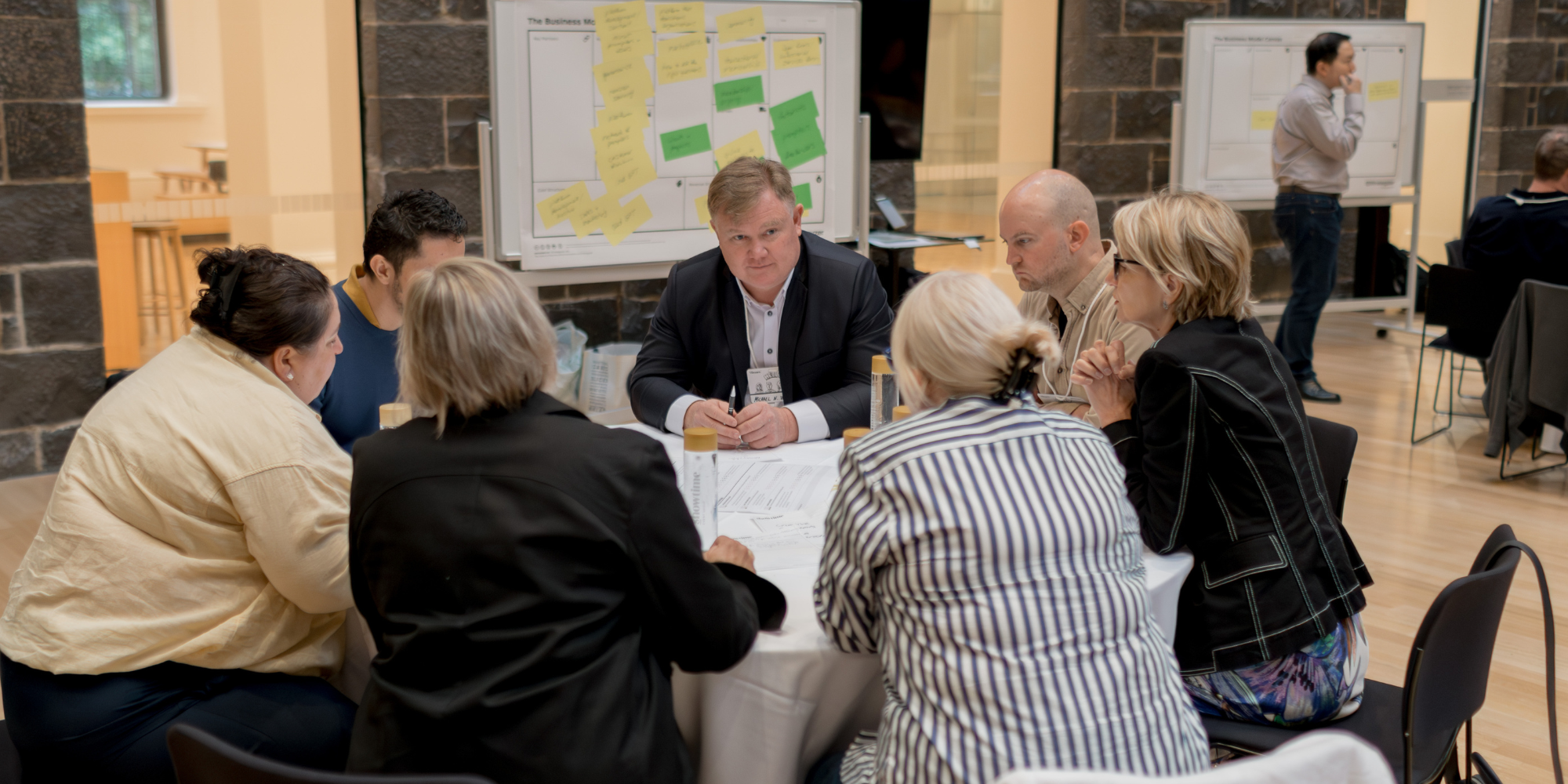
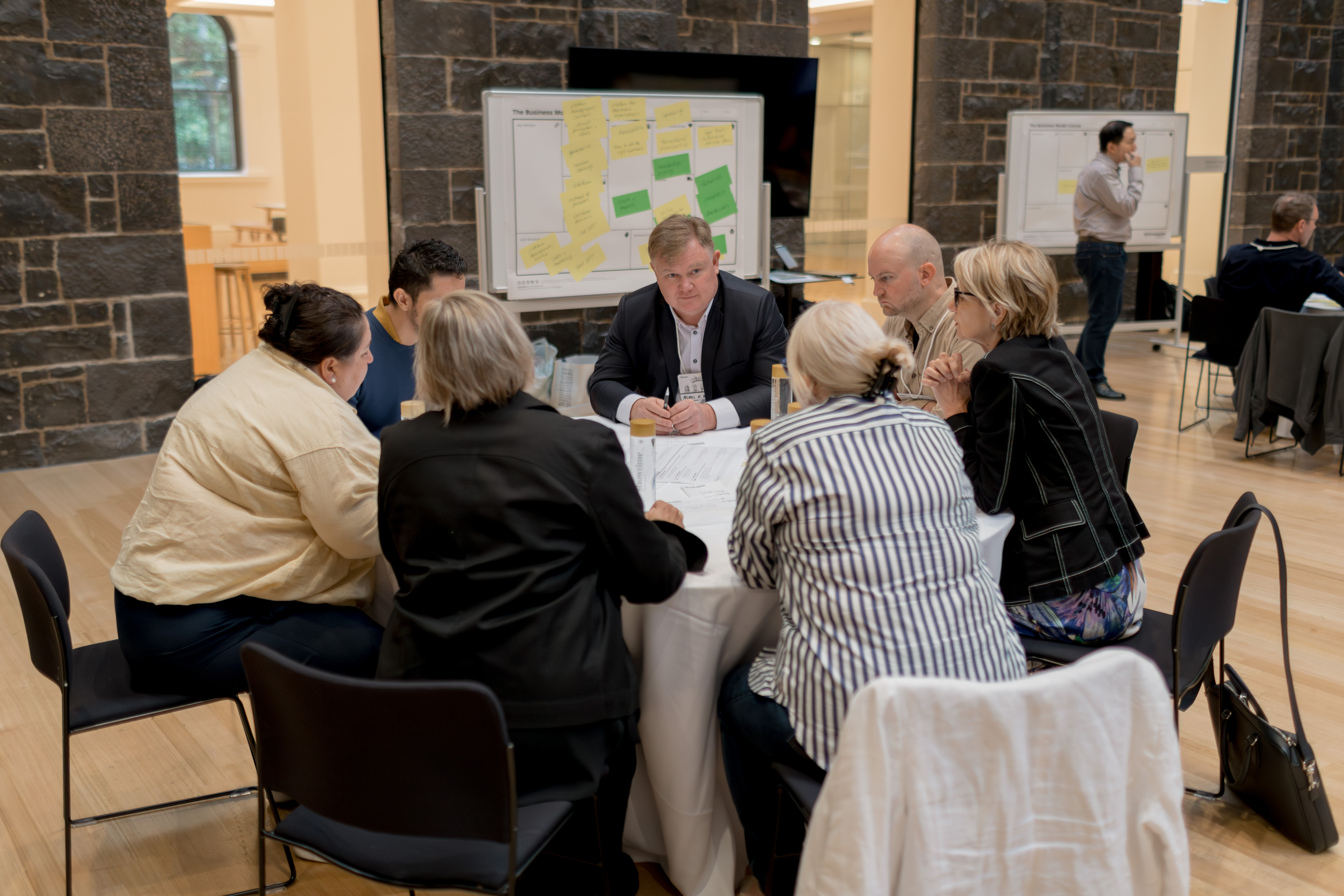
- Replace blah blah with visual tools. Abstract conversations drift. When teams use structured visual tools like the Business Model Canvas or the Customer Ecosystem Map, they move from vague debate to concrete artefacts. Shared language follows. Alignment follows from that.
- Build coherence across your tools. Each Strategyzer tool connects to the others. The Value Proposition Canvas zooms in on one block of the Business Model Canvas. The Portfolio Map zooms out to show the whole picture. When tools integrate, teams never lose the thread between customer insight and strategic decision.
- Design for active participation. Long presentation blocks drain energy. Short inputs, structured breakouts, and frequent interactions keep people engaged and produce better outputs. This applies to strategy sessions and team calls alike.
- Work iteratively, not perfectly. SpaceX launches its rockets far more often than NASA – and at far lower cost per launch. The difference is not budget; it is the number of iterations. The same logic applies to strategy and value proposition design. Prototype first. Refine fast.
- Use short, rapid exercises. A five-minute feedback session using de Bono's Thinking Hats can outperform a 30-minute open discussion. Two minutes for clarifying questions, one minute for what does not work, one for what does, one for improvements. One critical rule: the person receiving feedback listens and does not respond until the round is finished.

Start with the customer ecosystem – not just "the user"
One of the most common and costly oversights in B2B is treating "the customer" as a single person. The Kimberly-Clark example from the webinar illustrates this. Kimberly-Clark makes bathroom installations for public buildings. Their customer is not one person. It is a system: end users, building owners, contractors, economic buyers within contractor organisations, channel partners, and recommenders such as industry bodies.
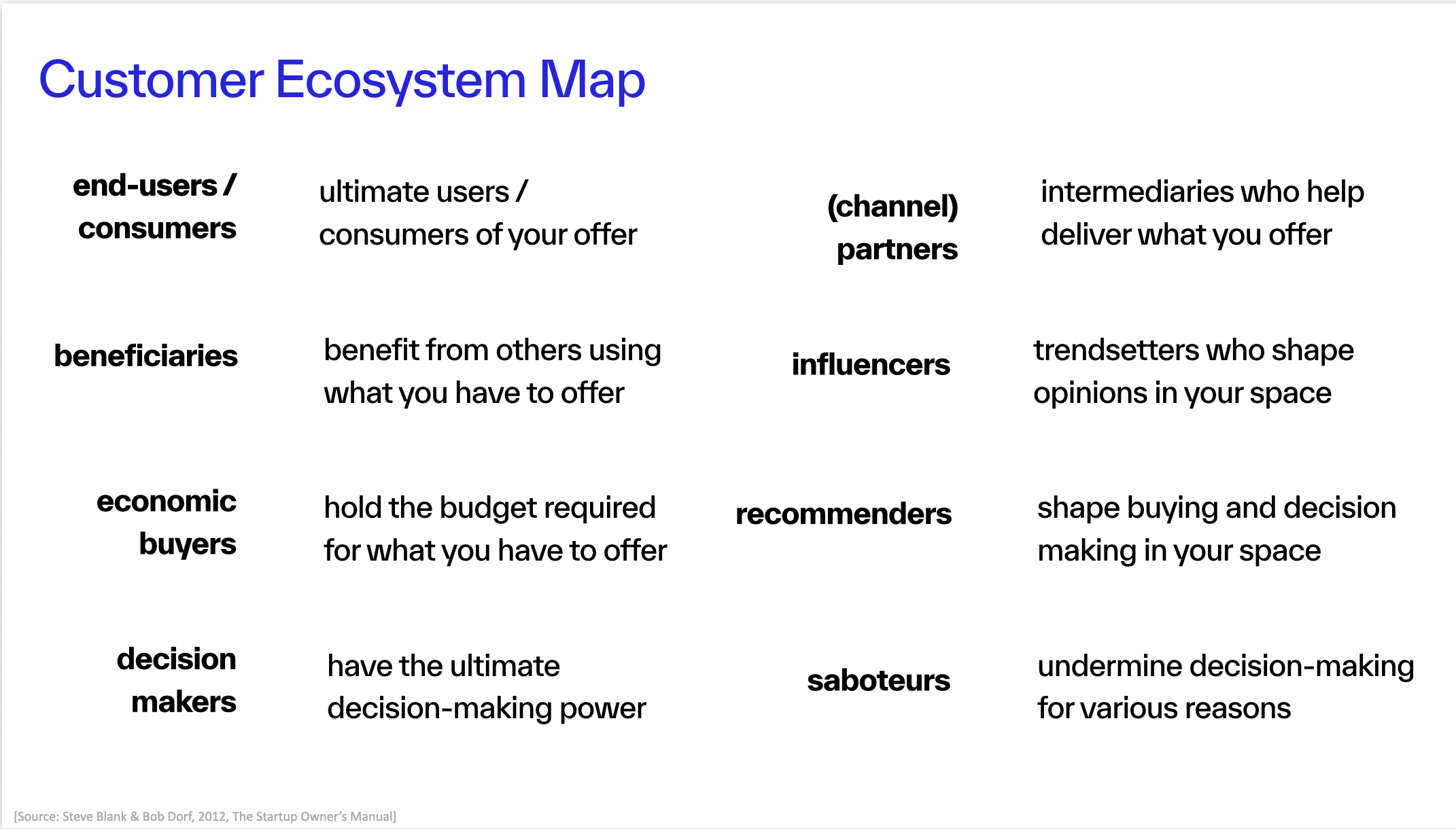
Strategyzer's Customer Ecosystem Map makes this system visible in 20 to 30 minutes. With eight defined roles – end users, beneficiaries, economic buyers, decision makers, influencers, recommenders, saboteurs, and channel partners – teams can see who they need to create value for, and who controls the sale.
The practical implication: if your value proposition speaks only to the end user, you may be missing the decision maker entirely. And if the decision maker has not bought in, the sale does not happen.
Why change programmes fail – and what social movements do differently
Most change initiatives are planned as programmes. They have roadmaps, workstreams, and milestones. They are often designed well. And they still struggle.
The reason is a gap between how leaders plan change and how people actually experience it. Leaders see a logical sequence of steps. Employees feel something being done to them.
A more productive frame: what if transformation were designed to work more like a social movement? The goal shifts from executing the roadmap to creating momentum. Visible results build buy-in. Buy-in enables more activity. More activity produces more results. The cycle reinforces itself.
This means designing early activities to produce results people can see. It also means understanding who your stakeholders actually are – and avoiding a common error: spending energy trying to convert your fiercest opponents. As Greg Satell argues in his book Cascades, momentum comes from activating allies and engaging the persuadable middle.
The nine personas of change
Tendayi Viki has developed a framework for mapping stakeholders on two dimensions: how they evaluate the change (positive, neutral, or negative) and how they participate (actively, neutrally, or against). The result is nine distinct personas, plotted on a 3x3 grid.
The five base personas:
- Bystanders – neutral on both dimensions. Watching and waiting.
- Opponents – negative evaluation, neutral participation. Passively resistant but not actively blocking.
- Blockers – neutral evaluation, actively working against. Procedural obstruction.
- Testers – neutral evaluation, cautiously experimenting. A good experience can move them toward champion.
- Supporters – positive evaluation, neutral participation. They agree with the change but are not yet contributing to it.
The four additional personas:
- Prisoners – actively participating but with a negative evaluation. Reluctant compliance under pressure.
- Saboteurs – negative evaluation and active resistance.
- Objectors – positive evaluation but strongly opposed to how the change is being executed. Often former champions who were burned. Handle with care.
- Champions – positive evaluation and active participation. Full buy-in.

When Alex Osterwalder saw this framework for the first time, his reaction was direct: "The first time Tendai showed this, I thought: this is a home run."
The practical implication: do not try to move everyone to champion at once. The goal is to move each person one step. Bystanders to supporters. Prisoners to testers. Objectors to supporters.
One critical watch-out: bystanders are frequently misclassified as opponents. As Tendayi Viki observed: "sometimes bystanders get treated like opponents when they're just bystanders. And the way you treat bystanders can turn them into opponents." A playbook to support this work is currently in development on the Strategyzer platform.
Applied formats – from courses to hands-on playbooks
Strategyzer has moved from traditional training courses to guided, step-by-step workspaces it calls playbooks – where teams discover concepts and immediately apply them to their real work. The shift is not just methodological; it is structural.
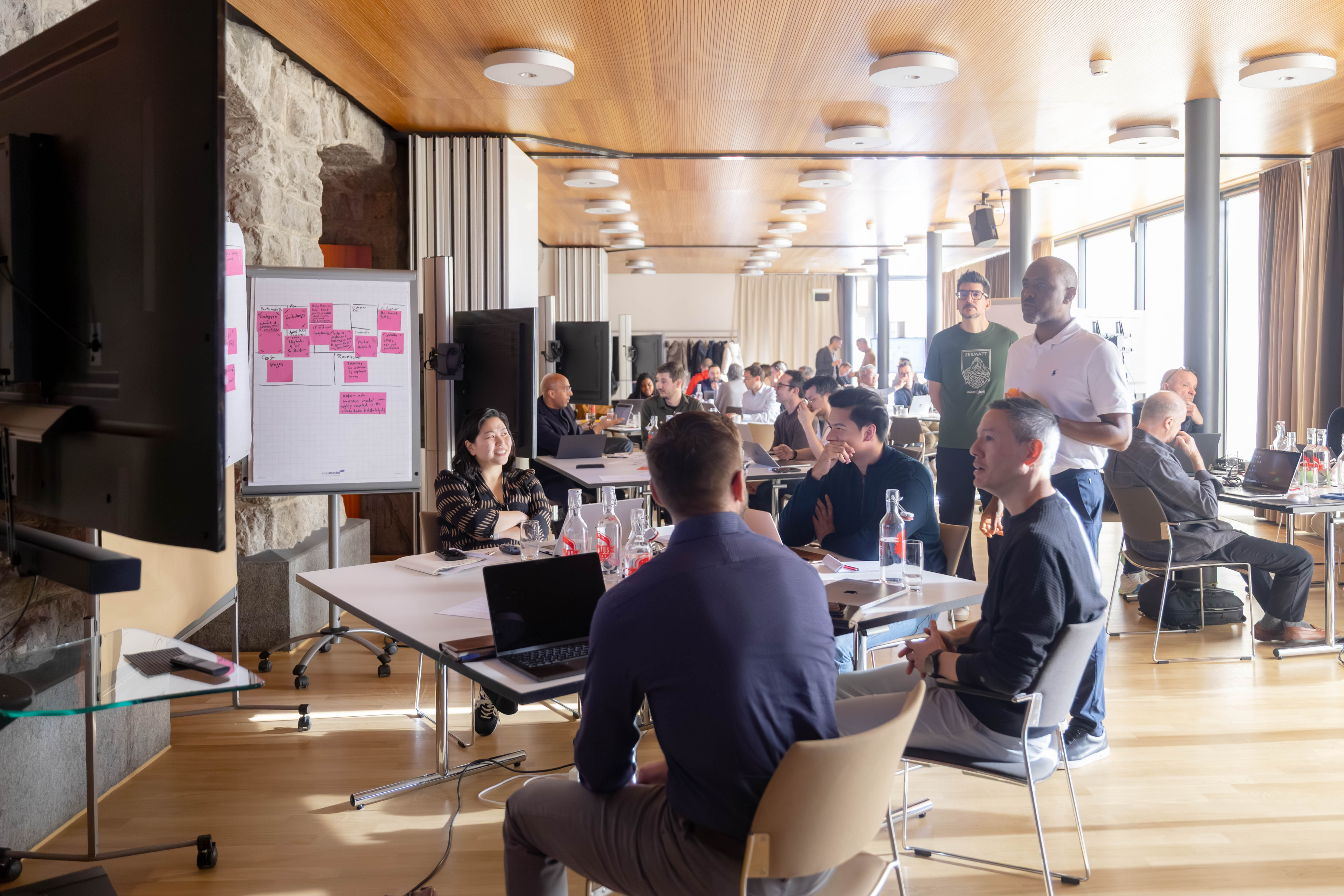
The Honeywell Growth Symposium is a published example. Teams completed six pre-work tasks on the Strategyzer platform before arriving at the workshop: a customer ecosystem map, customer profiles, value scenes, a business model, a financial prototype, and a set of known unknowns. On the day, they presented directly to leadership, who evaluated the strength of the evidence behind each idea – not just the idea itself. The Strategyzer platform structured every step.
The Playbook Library now covers value proposition design, business model strategy, and organisational change. Playbooks start at $300 per person and are accessible to individuals, teams, and independent coaches alike.
The Applied Masterclass Series takes this further. Alex Osterwalder facilitates the first two masterclasses – on value propositions and business model advantage. Tendayi Viki leads the third, on enabling organisational change through momentum and buy-in. Each includes pre-work on the Strategyzer platform, two live workshops, and real-world fieldwork. Participants work on their own business challenges throughout.
As Alex Osterwalder put it: "you get feedback from us on your real work at an extremely attractive price – something you'd never get from consulting."
Conclusion
The methods Strategyzer is known for have always worked best when applied to real work. What has changed is the format. Applied masterclasses, guided playbooks, and platform-based programmes now make it possible for teams to learn and apply at the same time – without the months of lag that follow traditional training.
The key constraint is rarely knowledge. It is momentum: having the right stakeholder map, the right activities at the right moment, and formats that produce results people can see. The nine-persona framework and the five principles give teams a concrete starting point for both.
The clearest next step: identify which principle your team is weakest on, and run one short, structured session around it. From there, explore the Strategyzer Playbook Library or join an Applied Masterclass to go deeper on your own work.
Download the slides from this webinar to revisit the five principles, the nine personas framework, and the Honeywell case at your own pace.
The Applied Masterclass Series is now open for enrolment. Each masterclass is built for individuals and teams who want to apply Strategyzer's methods to their own business challenges,with direct feedback from Alex Osterwalder and Tendayi Viki. Explore the series and reserve your place. Learn more