The hidden cost of not understanding your customers
Every organisation believes it understands its customers. But belief and evidence are different things.
Consider this scenario: a large company approached Strategyzer with an exciting new app idea. They had mapped out features, estimated costs at $800,000, and were ready to build. They wanted help commercialising the product.
Strategyzer recommended they start by interviewing customers. The company pushed back. They felt they were past that phase and did not want to slow down.
Eventually, they agreed to run interviews. The result? Customers had no interest in or need for what the company planned to spend $800,000 on.
"Customer interviews can help you avoid costly mistakes and maximise returns on key projects. The more unproven an idea is, the more a customer-first focus is needed."
— Kurt Bostelaar, Programme Design Lead, Strategyzer

Why traditional interviews struggle to produce decisions
For years, Strategyzer used free-flow interviews as their go to initial customer discovery experiment. They trained teams to ask the right questions, create scripts based on key unknowns, and analyse patterns in the evidence.
It worked. But there was a persistent tension.
Corporate teams face a core constraint: lack of time. When you spend a week or two learning interview techniques, setting up calls, running them, and then doing affinity mapping, the process becomes a significant investment.
"If you try to go really fast, we often found it negatively impacted their ability to get actionable insights that drive decisions."
— Kurt Bostelaar
Speed and quality seemed to pull in opposite directions. Until they discovered the power of visual artifacts.
The breakthrough: visual artifacts in interviews
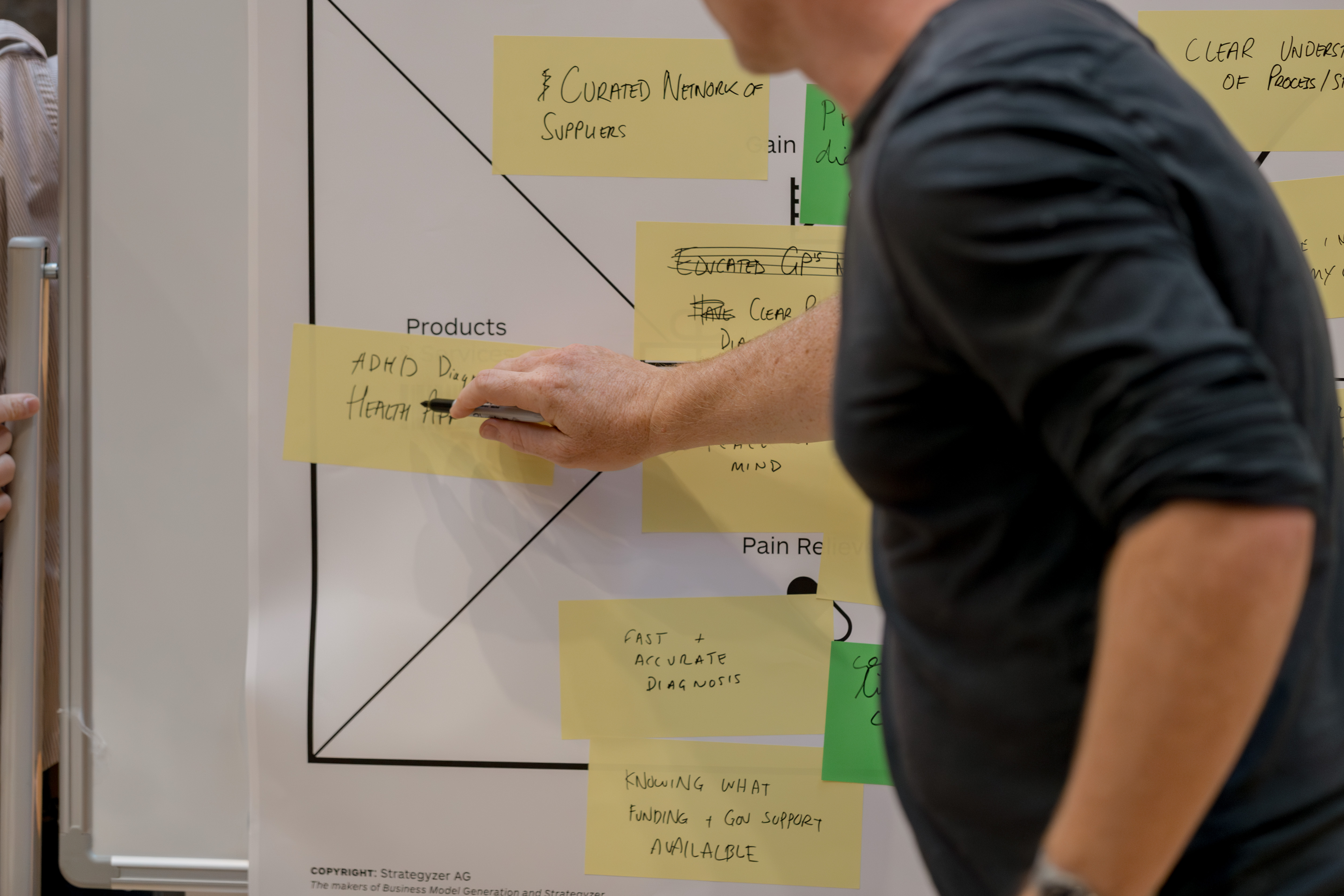
The shift started when Strategyzer began incorporating visual tools into their interviews. Techniques like speedboat exercises, where interviewees place sticky notes as anchors showing the depth of their pain points, or card sorts, where customers force-rank features from least to most important.
These visual approaches offered something free-flow interviews struggled to provide: quantifiable data combined with qualitative insight.
"With interviews like this, you could start to get some quantifiable data. This feature was ranked number one X percent of the time. While still capturing more qualitative insights."
— Kurt Bostelaar
Customer profile interviews: the method that changed everything
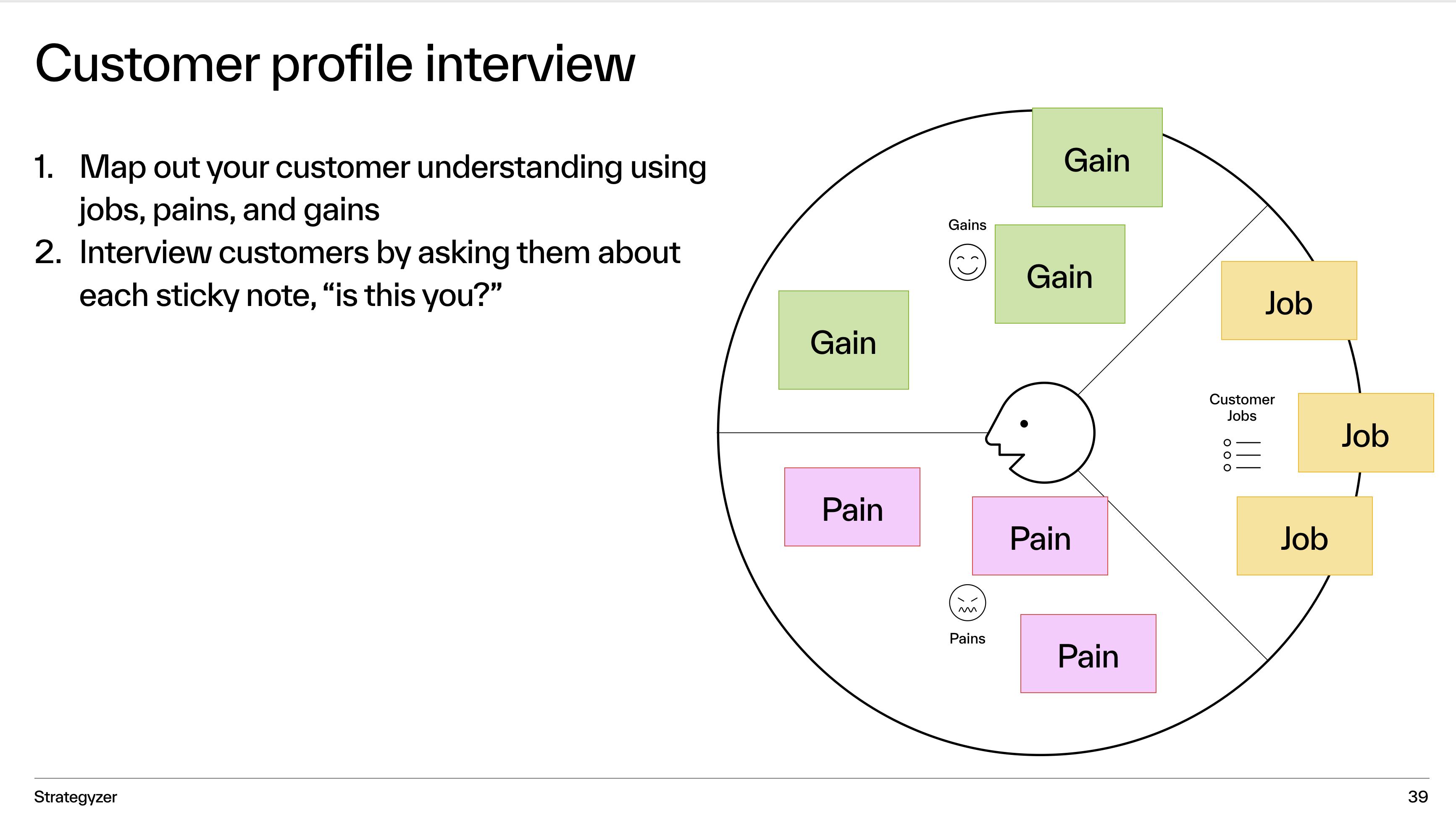
The breakthrough moment came when Strategyzer coach Paris Thomas started using the Customer Profile—the right side of the Value Proposition Canvas—as the visual artifact in interviews.
Step 1: Map your customer understanding
Before any interviews, the team creates a Customer Profile with sticky notes covering customer jobs (what customers are trying to accomplish), customer pains (obstacles, risks, and frustrations), and customer gains (desired benefits and positive outcomes). A typical profile might have 30-40 sticky notes representing the team's assumptions.
Step 2: Validate with real customers
In each interview, you work through the profile one sticky note at a time, asking: "Is this you?" Customers respond yes, no, or "not quite—here is how I would adjust it."
Step 3: Capture additional insights
After working through each section (jobs, pains, gains), ask: "Is there anything else?" This catches important customer realities that the team's initial assumptions missed.
Step 4: Force-rank priorities
Customers rank their top three jobs, top three pains, and top three gains. This prioritisation data becomes critical for decision-making.
What happens when assumptions meet reality
A Canadian consumer packaged goods team tested this approach. They had zero experience running customer interviews—the team came from marketing, sales, and product roles.
After just two meetings with their Strategyzer coach—one to map the initial profile, one to practise—they were ready to run interviews.
The results from 20 interviews were striking:
- On jobs: The team had mapped 34 job sticky notes. 91% of those were deleted at least once by customers who said "that does not apply to me."
- On pains: 55% of the pains the team assumed were true were not true at all for their customers.
- On gains: 75% of interviewees had comments about at least one gain sticky note, refining or correcting the team's understanding.
Why does this method speeds up decisions
The real power shows up at the decision point.
When the Canadian team presented to their leadership, they had evidence that was traceable. "Here is the data we found. Here is exactly what happened from those interviews. We recommend X."
"That decision was so easy to trace back to what happened. There was no questioning, there was no waffling."
— Kurt Bostelaar
Customer profile interviews produce three outputs that traditional approaches struggle with:
- Quantifiable evidence: "14 of 15 customers had this pain, and 11 ranked it number one"
- Comparable data: Because every interview uses the same structure, you can aggregate and compare across conversations
- Visual documentation: The validated profile becomes a shared artifact the entire team can reference
Ready to run customer interviews that produce insights, not notes?
Explore our playbooks to do great customer interviews at strategyzer.com/playbook.
Interested in the webinar slides? Download them here.